Emilio J. Castilla in Conversation with Renee Bales About The Meritocracy Paradox
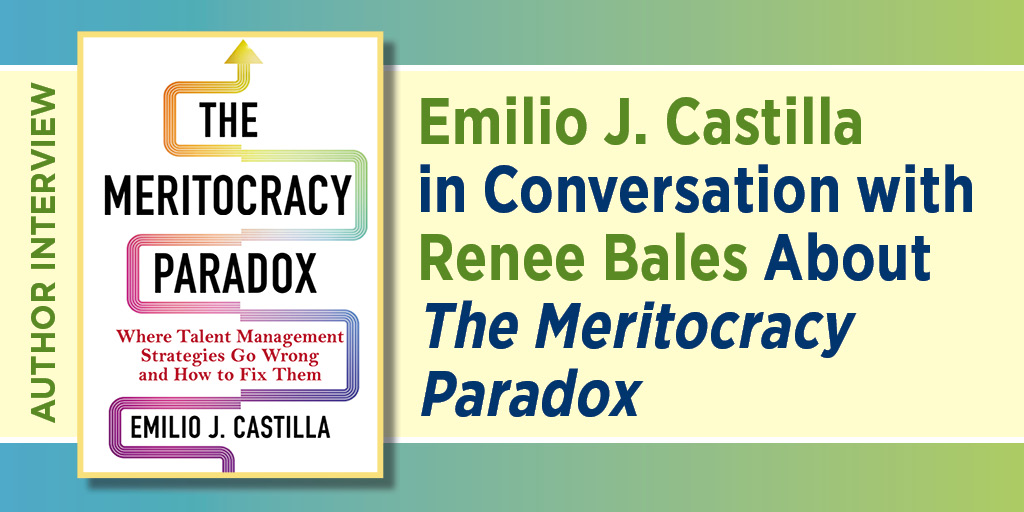
Equitability and fairness in selection and promotion processes are highly valued, but research has consistently demonstrated that organizations attempting to adhere to these ideals are often reinforcing the very inequalities they promise to overcome. In The Meritocracy Paradox, MIT professor Emilio J. Castilla explains why meritocracy goes wrong and how more equitable managing strategies can be implemented. Drawing on empirical research, he develops a framework for improving merit-based evaluation processes that can be applied by managers, recruiters, and human resource professionals in any sector. In this interview, Castilla and Renee Bales discuss the strengths and limitations of meritocracy, the state of merit-based evaluation practices today, and more.
Renee Bales: The Meritocracy Paradox contends that meritocracy, while highly valued in theory, often goes wrong in practice. Why is true meritocracy so difficult to get right despite its immense appeal?
Emilio J. Castilla: There are several intertwined reasons why attempts to build true meritocratic organizations can go awry, despite their theoretical appeal. One is the inherent difficulty of defining merit consistently across an organization. My research with Aruna Ranganathan of the University of California, Berkeley, shows that managers, even within the same organization, may have widely differing ideas about what constitutes merit—and different approaches to evaluating it, too. What one manager views as evidence of talent or potential, another may dismiss or undervalue. These variations mean that so-called merit-based decisions are often subjective and inconsistent, undermining the promise of fairness at the heart of meritocracy.
Then there’s the question of bias. Bias—whether explicit or unconscious—can potentially shape employment decisions at every stage, from who is interviewed and hired to who is promoted and who is rewarded for excellent performance. Many studies have shown that biases against a variety of groups—including women, Blacks, immigrants, people with disabilities, and members of the LGBTQ+ community, among many—can disadvantage these groups, even in organizations that claim to value merit.
Paradoxically, calling an organization meritocratic may even heighten the effects of such biases in talent management systems. In a set of experiments Stephen Benard of Indiana University and I conducted, we found that study participants tended to give male employees higher bonuses than similarly performing female employees if the participants were told the organization they were making decisions for was merit-driven and equitable. This is what we call the paradox of meritocracy: declaring an organization meritocratic can create a false sense of fairness and objectivity, which in turn licenses biased behavior. This dynamic is consistent with a recognized psychological phenomenon known as moral credentialing, where people who have been given a chance to feel virtuous (in this case, by being assured they are part of an organization that values meritocracy and fairness) are then more likely to subsequently behave in less-virtuous ways.
Ultimately, while meritocracy is an immensely attractive ideal—promising fairness, equality of opportunity, and the rewarding of talent and effort—the reality is that organizations operate within broader social structures that can potentially sustain workplace inequality and privilege. Without careful design and continuous scrutiny, meritocratic systems may reinforce, rather than address, these inequalities.
Bales: From the decades of research you drew upon to write the book, what stands out to you as the most common error made by leaders attempting to implement merit-based hiring and promotion practices?
Castilla: One of the most common and costly mistakes I see is that leaders jump too quickly into solutions without first taking the time to understand the actual problems or challenges in their own organization. I call this the “best practice trap.”
What often happens is that executives and managers look around at what other well-known or successful companies are doing—maybe it’s launching a new diversity training program, adding a bold mission statement regarding equal opportunity to the website, or adopting some popular performance rating system—and they copy those initiatives without stopping to ask: Does this address our specific issues?
It’s a bit like seeing your neighbor replace the muffler on their car and thinking, “I should do that too!” But maybe your car doesn’t need a new muffler; maybe it needs new brakes or an oil change. You wouldn’t make a repair without first understanding what’s actually wrong, and organizations should treat their talent systems the same way.
In my research, I’ve found that every organization has its own unique set of barriers, hidden biases, and talent management challenges. For example, one company might have unclear criteria for promotions that allow subjective impressions to be influential. Another might have unequal access to mentorship and stretch assignments, which are crucial for career advancement. Yet another might struggle with biased performance reviews that consistently undervalue contributions from certain groups.
Another big error is assuming that simply having formal processes in place to recruit, hire, and evaluate performance automatically makes them fair or truly merit-based. In reality, my research shows that biases and inefficiencies can easily seep into these systems, resulting in outcomes that undermine meritocracy rather than uphold it. For example, in my study of a large U.S. service organization—which had implemented a performance-reward system designed to translate evaluations into bonuses and salary increases—I found that even when employees received the same performance scores, women and racial minorities consistently received smaller salary increases than white men. This phenomenon, which I call performance-reward bias, underscores how formal talent management processes may sustain workplace inequality based on non-meritocratic factors, even when formal criteria appear neutral on paper.
On top of that, many leaders don’t realize how deeply existing social forces can shape who gets access to opportunities in the first place. Even if you think your promotion process is fair on paper, certain groups may have faced barriers long before they entered your pipeline—like fewer chances to take on high-visibility projects or fewer sponsors advocating for them.
So the biggest mistake is confusing quick fixes and symbolic gestures with real, structural change to address meritocratic challenges. If leaders truly want to build merit-based talent management systems, they need to start by looking inward: gathering and analyzing data, listening to employees and managers, examining each step of their recruitment, hiring, performance evaluation, and promotion and pay processes, and asking where bias and other inefficiencies might be creeping in. Then, and only then, should they design solutions tailored to their organization’s specific challenges.
Real meritocracy isn’t about adopting flashy best practices—it’s about doing the patient, often uncomfortable work of making sure that every employee has a genuine, equal chance to succeed.
Bales: How have your own encounters with merit-based selection processes while navigating the academic world influenced your perspective on this subject?
Castilla: My experiences in academia have deeply shaped the way I think about meritocracy—not just in theory, but in practice. Academia often claims to be a bastion of merit-based evaluation and subsequent rewards: We talk about “the best ideas rising to the top,” about “admitting the most talented students,” and rewarding the most meritorious scholars. But in reality, we have seen firsthand just how much these systems can fall short of that ideal.
For example, Ethan J. Poskanzer from the University of Colorado and I conducted a study of legacy admissions—the practice of giving preference to children of alumni—at a highly selective college in the Northeastern United States. (To be clear, it wasn’t MIT, which does not give legacy preference.) We found that legacy applicants received a substantial advantage in admissions decisions, and this advantage overwhelmingly benefited white students and those from wealthier families.
Even more striking was what we discovered about why this practice may still persist. It wasn’t just about tradition or loyalty, or because of the quality of the applicants the practice helped generate—there were clear economic incentives. Legacy students were, on average, less likely to need financial aid if they enrolled at the college, and, after graduation, were more likely to donate to the college. In other words, what was presented as a selective (merit-driven) process was actually shaped by financial considerations and existing privilege.
That study really highlighted for me how easily systems that are supposed to reward individual achievement can end up reinforcing social and economic inequalities instead. It also mirrors what I’ve seen throughout my career: the subtle ways organizations (including universities and colleges) talk about “merit” while simultaneously maintaining practices that may favor certain groups of candidates, jeopardizing what I see as one of the key conditions for the successful implementation of meritocracy: equal opportunity for all.
More broadly, these experiences have shown me that no system—no matter how well-intentioned—is immune to bias, barriers, or preferences. Even in academia, which prides itself on fairness and objectivity, access to mentorship, research opportunities, or prestigious networks often depends on informal connections and unspoken rules rather than purely on talent.
All of this has reinforced my belief that to create truly fair and meritocratic systems, we can’t just declare them “meritocratic” or “strategic talent management,” and assume they’ll work as intended. We have to dig deeper, question who benefits and who does not and why, and continually examine and redesign our talent management processes to align with our values. My academic journey—both as a researcher and as someone navigating these systems myself—has made me acutely aware of just how much work it takes to move from the ideal of meritocracy to the reality of it. Meritocracy is always a work in progress: difficult to achieve in practice, and something that requires constant effort and vigilance to sustain.
Bales: You argue in the book that recruiters’ definition of “merit” or “talent” is often subjective, leading to bias in hiring and promotion processes. In your view, is it possible to measure merit objectively? If so, what steps can recruiters take to establish a more objective definition?
Castilla: In many settings, it may never be fully possible to measure merit in a completely objective way. As I discuss in The Meritocracy Paradox, what counts as “merit” is often, to some degree, in the eye of the beholder. It involves judgments about what it means to be talented and about potential, “fit,” and leadership qualities—all factors that can easily be shaped by subjective impressions, existing biases, and unspoken cultural expectations.
But this doesn’t mean we should throw up our hands. Even if we can’t achieve perfect objectivity, we can strive to make our talent management systems as fair and consistent as possible. For recruiters and leaders, a crucial first step is to clarify and define what “merit” actually means in the context of a specific role. Rather than relying on vague notions of “talent” or “star quality,” organizations should break jobs down into specific, measurable skills and competencies—and then ensure that evaluation criteria are aligned with these clearly articulated requirements.
Next, it’s essential to standardize assessments and decision-making processes. For example, structured interviews, in which each candidate is asked a similar set of job-relevant questions and evaluated on the same rubric, have been shown to reduce bias and improve predictive validity compared to more free-flowing, unstructured interviews.
Companies should also ensure that they gather and analyze data on hiring, promotion, and compensation outcomes to check for patterns of potential bias or other unintended disparities and inefficiencies. This kind of ongoing monitoring helps organizations catch problems early and adjust their practices accordingly.
Finally, it’s important to recognize that even well-designed systems can’t operate in a vacuum. Broader social structures and dynamics often shape who has access to opportunities, networks, and credentials in the first place. Organizations need to be mindful of these barriers and consider how to expand access to opportunity more broadly—for example, by rethinking degree requirements, providing equitable access to mentorship, and designing inclusive pipelines.
In short, while a purely objective measure of merit may be an unattainable ideal, organizations can and should work toward greater fairness and rigor in how they define and assess talent. Doing so requires moving away from gut feelings and charisma-based judgments and investing in thoughtful, data-based analytical approaches that truly reflect the values of a meritocratic system—not just the label. I elaborate on this in my book.
Bales: This book is coming out at a moment when attempts are being made to roll back Diversity, Equity, and Inclusion (DEI) programs in the United States. What’s your outlook on the future of fairness and inclusivity in hiring and promotion practices?
Castilla: The research is clear: Biases, often unconscious, can routinely creep into people management decisions, from hiring and promotion to compensation and access to high-impact opportunities. The same applies to social processes and barriers which can interfere with the efficient talent management strategies of organizations. Further, simply calling your organization “meritocratic” does not make it so. In fact, as I discuss in The Meritocracy Paradox, using that label can sometimes make bias worse, by giving people a false sense of objectivity and fairness.
Despite the current backlash against DEI initiatives in some quarters, I remain cautiously optimistic about the future of fairness and inclusivity in organizations. In the long run, I believe that organizations that build truly meritocratic systems—systems that offer every employee a genuine chance to succeed regardless of background—will have a clear competitive advantage.
Attracting, developing, and retaining the best talent requires casting the widest possible net and ensuring that opportunities aren’t limited by bias or historical patterns of exclusion. Companies that fall back on “old boys’ club” practices or allow unchecked biases to shape decisions may find themselves at a serious disadvantage—both in attracting top talent and in adapting to a rapidly changing, diverse world.
Moreover, many younger workers today place a high value on fairness, transparency, and inclusion. Organizations that ignore these expectations risk alienating not only talented potential hires but also their own future leaders.
That said, creating fair and inclusive systems isn’t just about maintaining a set of programs or checking a compliance box—it’s about doing the harder work of building robust, consistent, and transparent talent management practices. It’s about defining merit as clearly as possible and evaluating it rigorously, being vigilant against bias at every step, and ensuring that access to key assignments and advancement opportunities is equitable. This requires collecting and analyzing data not only on the talent management processes employed by the organization, but also their employment outcomes.
Ultimately, I see meritocracy and inclusion not as opposing goals but as deeply interconnected. True meritocracy—the kind that genuinely rewards talent and effort—is impossible without inclusion. It requires ongoing commitment and continuous monitoring and analysis, not just slogans.
While the path forward may be challenging, I believe that organizations whose leaders embrace this work thoughtfully and persistently will be better positioned to thrive—and to live up to the promise of fair and truly meritocratic workplaces.
Bales: Do you have any final thoughts you’d like to share about this topic?
Castilla: Not everyone is aware that the use of merit-based systems in employment is a very old concept. For example, around 200 B.C., the Han and Qin dynasties in China recognized the need for competent government officials to administer the growing Chinese empire. So they developed what we would now call civil service exams to identify talented individuals, regardless of background. This early move toward evaluating people based on ability rather than birth was revolutionary at the time.
In modern Western societies, the rise of merit-based systems was similarly viewed as a progressive alternative to systems rooted in aristocracy, social class, patronage, or outright corruption. While today we rightly critique many ways that meritocracy falls short in practice, it’s easy to forget that it was originally seen as a radical step toward fairness and opportunity for all.
Interestingly, the term “meritocracy” itself comes from a twentieth-century satirical novel written in the mid-twentieth century, which was very critical of the concept and its potential to create new forms of inequality and unfairness. And indeed, as I explore in The Meritocracy Paradox, meritocratic and other so-called talent management systems can create or reproduce privilege if they aren’t carefully designed and constantly scrutinized.
But despite its flaws and the real risks of reinforcing inequities, I still believe meritocracy is an ideal worth striving for. The solution isn’t to abandon it altogether, but rather to keep refining it—to make it more inclusive, more transparent, and more aligned with rewarding true talent and effort.
Ultimately, meritocracy should be seen not as a static state we can simply declare and celebrate, but as an ongoing project—one that requires vigilance, humility, and a willingness to monitor outcomes and challenge our assumptions at every turn. When we get closer to true meritocracy, our organizations don’t just become fairer; they also become more efficient, more innovative, more competitive, and more dynamic, better positioned to attract and retain the very best talent—wherever it comes from.