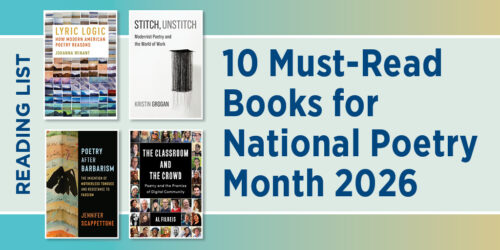
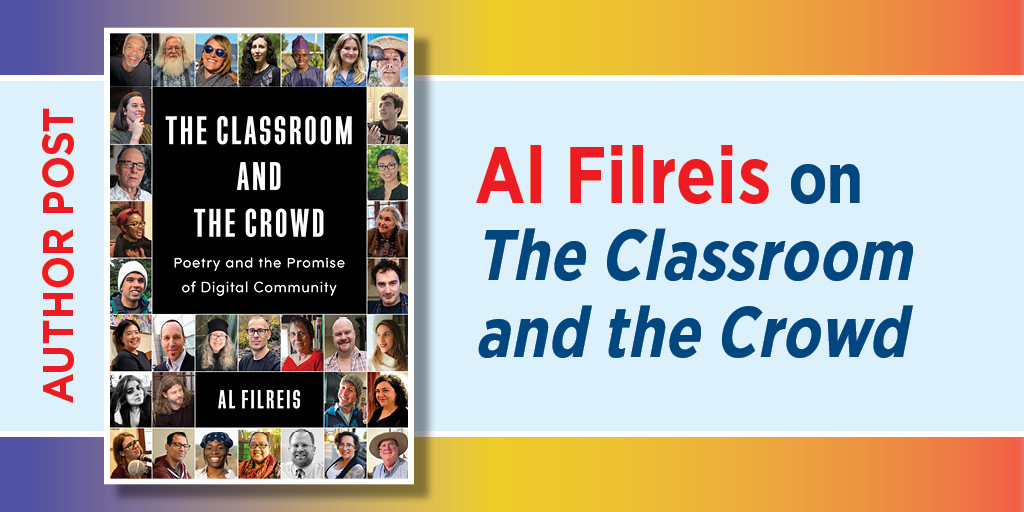
Al Filreis on The Classroom and the Crowd
Before composing this commentary, I checked the number of people who are currently enrolled in a course I teach on a topic that strikes many, if not most, people as nice but ultimately peripheral, inconsequential, quaint, of little moment: poetry. And not just poetry, but, in particular, experimental or “difficult” poetry—the kind of writing that necessitates focus and time, and the kind of reading that requires a tolerance of initial befuddlement. The sort of time and concentration most people apparently don’t have. We’re in the midst of a great moral panic about inattention, made more intense by urgent national and global crises. It is claimed almost daily that people devote less time to extraneous things that are enigmatic or opaque. My course, which we call “ModPo,” exclusively features puzzling, unobvious materials and lessons. Yet, as I learned before writing these words, 98,861 people are enrolled. In a few weeks, we will reach 100,000. Why?
My book, The Classroom and the Crowd, is an attempt to explain why all these people come, why they read and linger to talk about poems, and (for many of them) why they stay. Who are they and what are their motivations? My co-conveners and I created this free, noncredit, open online course in 2012, and by 2013 we were already wondering why it was so surprisingly popular. Because of her name recognition, her importance to the American canon, we could see why Emily Dickinson would attract readers and learners. “I dwell in Possibility — / A fairer House than Prose” is not easy reading, to be sure, but it’s Emily Dickinson, after all, and one must try to know the expressions of such a key figure (in week 1 of the course). But what, for example, about Bob Perelman? Here’s a stanza of his poem “Chronic Meanings,” encountered in week 8:
The coffee sounds intriguing but.
She put her cards on.
What had been comfortable subjectivity.
The lesson we can each.
One cannot easily comprehend what Perelman is doing in this truly beautiful pre-elegy for his friend Lee Hickman without reading through at least several times, witnessing our improvised collaborative close reading of the poem, and joining the open discussion of the poem in the ModPo forums, where hundreds of people are grappling with the idea that the impending death of a friend (from AIDS) should not be met by coherent, well-assimilated phrases and lines. The idea is a subtle one: an elegy that is incoherent paradoxically best reflects the power of emotional loss. And who, in a free ungraded course they’re doing for a few hours during the busy week, has time for such subtlety?
Apparently, many people do indeed have such time. Or can make time somehow. When a friend offers you coffee, but you decline because you are very busy and can’t sit down to confer over it, and this might be your very last conversation together, you will regret it later. Perelman set himself a hard rule: each line must be cut off after five words. Who remembers what came after making an excuse and declining to stay and talk? “The coffee sounds intriguing but…”—but what? That what is lost to time or memory, and in any case is eliminated by the five-word constraint. If lives are cut short, perhaps a poem’s lines should be too. A harmonious idea born of disruption and disjunction.
Poetry’s agreed-upon marginality seems to have freed us from the intense polarization, sectarianism, and rigidity we see in some online spaces.
The ModPo people make time. Somehow. They are invited to coffee, as it were, and they stay for it. No regrets! Occasionally they post to the forums to tell us how they manage to continue participating in reading, writing, discussing, joining meet-ups both in-person and virtual, phoning in during our live webcasts, indulging their long-suppressed passion for writing their own poems, staying up into the wee hours to join a conversation across major time zone differences. In 2013 Amaris Cuchanski (one of the founding Teaching Assistants) and I interviewed 100 ModPo learners. Among our questions were: Why did you decide to join the course? What is your motivation for going online to be part of this poetry community? The answers were so various that the only way to present them in my book was not to attempt any generalization but simply to create a list of the reasons. That list occupies three pages in the final chapter. My editors at CUP tolerated this excess. Perhaps they sensed that those pages, although a catalogue of others, are the most personal my writing has ever gotten.
The book’s subtitle is “Poetry and the Promise of Digital Community.” My experience offering ModPo for nearly fifteen years by now has given me hope. I am hopeful about the humane aspects of open online discussion, free (in several senses) digital discourse, honesty between and among strangers. It might be that choosing poetry as the excuse for our vast global convening has been the trick: poetry’s agreed-upon marginality seems to have freed us from the intense polarization, sectarianism, and rigidity we see in some online spaces.
But there’s more, I think. I’ve heard from many ModPo people that they are tired of those advocating “digital minimalism” making assumptions about the qualities of the online community. Digital minimalists advise unplugging, logging out, going offline. As a response to pernicious social media, and to the overwhelming top-downism of tech corporate edgelords, this moralism seems reasonable and does point toward some habits of better daily health. Yet the ModPo citizens often suspect that this moral panic threatens to leave them out: elderly folks who have less-than-ever access to our built social commons; people dozens or hundreds of miles away from universities, libraries, cozy bookstores, and other spaces where writers and readers tend to gather; people whose disabilities require asynchronous engagement—marked by the way they take their own time, characterized by repeated connections—and who feel real bias in face-to-face situations; people who are in transit, far from home, dislocated by political or climate effects; learners who are seeking the sort of global friendships that for many reasons can’t be had locally. Digital minimalism—our current panic against online life—seems to be a privileged localist stance that leaves many people out, perhaps indeed a majority of our 98,000. The “promise” of digital community presented in my book makes me, I suppose, a digital maximalist! In ModPo there’s just too much going on for me to keep track of. So rather than fretting about being the teacher who doesn’t know everything that’s happening in his classroom, I embrace the chaos as collaborative interpretation befitting (not contradicting) humane education in our time.
Al Filreis is Kelly Family Professor of English, founding faculty director of the Kelly Writers House, director of the Center for Programs in Contemporary Writing, codirector of PennSound, and publisher of Jacket2 magazine, all at the University of Pennsylvania. He is the author of The Classroom and the Crowd: Poetry and the Promise of Digital Community.