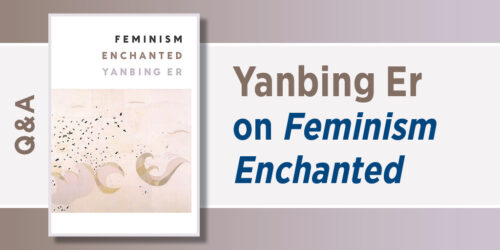
What does it mean to write a poem in a world governed by the demand to work hard for a living? Kristin Grogan’s Stitch, Unstitch: Modernist Poetry and the World of Work argues that this question was asked with particular urgency in the first half of the twentieth century when, against radical upheavals in political, social, and economic life, what it meant to be a worker—and a writer—was reshaped?. Modernist poetry emerges as a surprising archive for rethinking the relationship between the work of art and work in general, and for imagining life beyond labor. With chapters on canonical and overlooked poets and drawing on a Marxist-feminist approach that emphasizes unseen and undervalued labors, Stitch, Unstitch places utopian thinking back at the center of our histories of both labor and poetry.
Q: Tell us about the title.
Kristin Grogan: The title is a riff on modernism’s most famous poem about poetic labor: W. B. Yeats’s “Adam’s Curse.” In that poem, Yeats complains about how hard poets have it: “A line will take us hours maybe; / Yet if it does not seem a moment’s thought, / Our stitching and unstitching has been naught.” For Yeats, poets must work hard to craft beautiful lines, and then they must work hard to make it look like it all happened effortlessly. It’s a tricky little poem; Yeats compares the poet’s labors to the drudge work of “an old pauper” scrubbing floors, and he sets the poet against “the noisy set / Of bankers, schoolmasters, and clergymen.” Meanwhile, this whole theory of writing takes place in a conversation with a “beautiful mild woman” who reminds the poet that “we must labour to be beautiful.” I wanted to open up all of the ideas in that poem: of poetry and value in a world defined by work, of poetry’s relationship with gender and femininity, and of what it means to be a poet in the early twentieth century.
Q: Why these poets in particular? Were there other poets or chapters that didn’t make it?
Grogan: I write at length about five poets—Ezra Pound, Lola Ridge, Langston Hughes, Gertrude Stein, and Lorine Niedecker. They all do something quite different, and each poet takes us to different terrain—politically, geographically, and aesthetically. Ezra Pound was a committed fascist, and my chapter on him is about how his idea that art is a special kind of craftwork is intertwined with his fascism. There’s a big jump between Pound and the subject of the second chapter: Lola Ridge, a Dublin-born, New Zealand-raised poet who moved to the United States and wrote poems about young women working as garment workers on the Lower East Side. The diversity of poets and poems is the point: I want to show that labor, as a concern, cuts across lines of gender, class, politics and race; that labor was a problem that poets traded over in this time.
There are so many poets who aren’t present, or only in the background—I would have loved to have written about Muriel Rukeyser’s Book of the Dead, which focuses on an industrial disaster in West Virginia. I’d love to have written on Claude McKay’s sonnets. There’s a version of the book that stretches right up to the present and includes the many poets writing about labor against the upheavals of our own time. But word counts must be obeyed.
Q: Why did you choose to focus on poetry? Do poets have a special insight into labor?
Grogan: I’m less committed to the idea that poets have some special insight into labor than that poetry can ask questions that other forms of writing can’t do, or can’t do as well. Part of this is that poetry is less beholden to narrative and representation; it uses language in all sorts of weird and marvellous and elastic ways that open the world up to new examination. Poetry has always seemed to me a bit like theory at its exploratory best: It examines and imagines the world otherwise. There’s a strong utopian impulse in this book, too. Poets are also people who hold down jobs and live in the world. Like most people, most of them would like to spend less time working and more time making art.
Poetry has also long been associated with uselessness, idleness, and non-commodification. Yeats calls it “an idle trade enough.” There are all sorts of ways that the poets I study put pressure on this idea: Pound thinks that poetry is a serious, society-ordering thing. Stein, on the other hand, flirts with and sometimes leans into its uselessness. Poetry has a uniquely fraught relationship with capitalism’s values of hard work, usefulness, and productivity: that was my starting point.
Q: You talk about poems written today, but your focus is the first half of the twentieth century. Why do you focus on modernism?
Grogan: Modernism is endlessly fascinating to me: It’s an aesthetic movement, but it’s also an entire social world and a collective project. The political soil from which it emerges is incredibly fertile: This is the era of radical politics and revolutions, of migrations, of upheavals in how work is organized and what it means. These changes are negotiated in many different ways, but the turmoil is a shared condition.
I’m also interested in poets that came after modernism, that take up and trouble and sometimes negate its ideas and its forms, and those poets are sprinkled throughout—Lyn Hejinian, Rachel Blau DuPlessis, Anne Boyer, Bernadette Mayer. Returning to modernism can explain a lot of what happens in the poetry that comes after—both in terms of what these poets take from modernism and what is distinctive about the poetry written nearer to today.
Q: How does the work of writing a book like this, or the work of teaching these poems, relate to the lessons about labor that you elaborate from the poems you discuss?
Grogan: In the book, I write about poets finding forms of sociality within labor and class struggle, articulating it in their writing. Lola Ridge writes poems about the New York garment trade, and her subjects are these young women who are political radicals and thinkers who also just live wild and unfettered lives. But the point is that they’re reimagining solidarity from this historically specific world. That chapter ends with a reading of Garments Against Women, Anne Boyer’s book of prose poems. There’s a moment where the poet learns to sew, and that’s a way of accessing the archive of the past, the struggles of the women who went before her and whose struggles are both like and unlike hers. Reading poetry of the past is one way of accessing our shared historical struggles and of trying to make better ways of being together in the present and the future.
Q: Finally, what’s your favorite poem in the book?
Grogan: So many! One poet I’ll always return to is Gertrude Stein; she is the focus of chapter 4, which is about the relationship between Stein’s writing, domestic life, and queer intimacy. I find Stein endlessly funny, frustrating, infuriating, and generative to think with. The patron saint of the book is probably Lorine Niedecker, and I open the book with her stunning short poem “Poet’s Work,” which ends: “I learned / to sit at desk / and condense // No layoff / from this / condensery.” The poem is nine lines in total, and I’ve been reading it closely since I started the project. I will probably keep reading it for a long time to come.