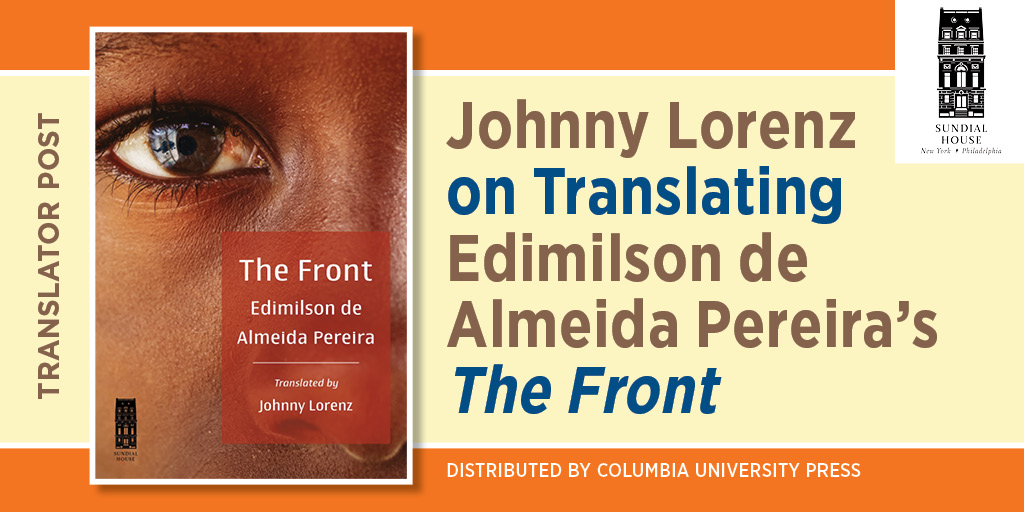
A fortunate accident of translation occurs in the line above, taken from the novel The Front, the slender and astonishing book by the Brazilian novelist, poet, and scholar Edimilson de Almeida Pereira. The word “missals” (liturgical books) might be misunderstood, or misheard, as “missiles,” its homophone and a much more common word in secular society. In the English translation, however, this confusion between “missals” and “missiles” suggests, rather fittingly, that language can operate as a weapon, as a form of oppression. It’s a weapon that possesses, too, a liberating potential.
The unnamed narrator of The Front stands in line for the entirety of the novel, waiting. And waiting. His mind wanders, analyzes, remembers. He remembers, for instance, his childhood days spent exploring the city garbage dump near his home. The dump, the discarded archive of the city, is where our narrator learns how to read and become an author himself. He forages for torn pages, and he fashions a new book for himself from dismembered user manuals and other random texts. The new book becomes his talisman, protecting the boy from the dangers of the dump. And from the police helicopters patrolling the skies.
It is this understanding of language—as something torn, incomplete and resurrected—that informs the writing of The Front. The narrator interrogates the reality that has been conjured for him. Or, we might say, conjured against him.
Maybe I’m taking things too far: to not become accustomed to, to not accept the, to not be sorry for…. “No” is a serious word. Outside of syntax, but crucial for saying yes to life: no falling, no obeying: new words begin with this no so that we do not die: it means being born again, our faces no longer pressed against the wall. There’s a window with a landscape before us: not asking permission to go there, it’s a kind of joy; not begging for our lunch is a revolution.
Resistance is couched here as something linguistic: our narrator learns to say “no.” This “no” is also a “yes”—for it opens new possibilities, new ways of being that do not rely on the definitions and categories imposed upon him.
I never wanted a name to anchor me. I am nameless to be many names.
This is the fundamental refusal of The Front—and the beginning of our narrator’s analytical and creative work—as he tries to understand the world in which he finds himself by troubling the discourses it deploys. (For instance, in The Front, the official language of “public health” is a kind of double-speak used by agents of the state to obscure their own surveillance practices.)
Our narrator refuses to say his name because he refuses to be limited by the word that has been given to him, the word that “tells” him. At a young age, he learns that resistance relies on an imaginative power. He doesn’t try to avoid the garbage dump to which he’s been relegated, nor does he simply accept it; instead, he resurrects and transforms the garbage. In doing so, he refuses to submit to the terms established by the system.
There are moments in the book when garbage becomes a brain. Or a book. Or an oracle. Language is like that garbage dump, full of worn-out metaphors. The narrator fashions something new from it. But language also has its sharp edges. Its pollution. One must be brave when handling it.
Toward the very end of the novel, the narrator finds himself still waiting in that endless line, but then suddenly he realizes that a line of people, too, can be transformed. It can move from being a symbol of oppression to one of resistance. The narrator says that he and the others in line are now holding a bomb: “a bomb made of words.”
A book that is so linguistically self-aware, so poetic, so inspired by the silences that exist beyond what is being said—such a book is necessarily a challenge for the translator, who must face profound and intriguing uncertainties on every page, in every line.
The book never falls back on narrative autopilot. It gives the translator—and the reader—no place to rest. Clarice Lispector once wrote that writing is this: “?” She did not imagine writing as the elegant arrangement of words on the page but as the destabilization of one’s own language, a language that is, perhaps, not really one’s own.
As soon as I was able, I became a man-tree. An affront to the machine. A zero in flames.
The narrator of The Front chooses not another, better name for himself, but no name at all. He is a man-tree but still someone, or something, anonymous. A zero. Nothing. But something. Something in flames. These are the exciting paradoxes the translator must attempt to convey in another language, a language with its own beauty, its own blind spots. (Often, it is beauty itself that produces the blind spot.)
Here is another refusal articulated by the man-tree:
I refuse to be the thread limited to the eye of the needle. We exist for some other orbit, we’re meant to head toward a different star.
There are a number of ways that we might read this passage. Here’s one: the self—or the story that the self tells about itself—is part of a much larger design. But not necessarily. The writer can refuse… and disrupt. It’s the unruly thread that The Front favors.