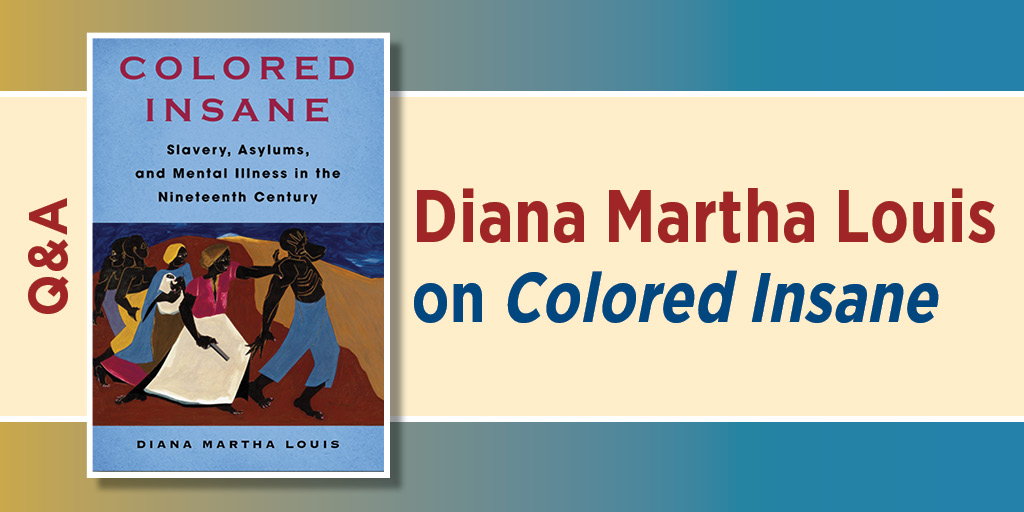
The nineteenth century in the United States witnessed the end of slavery and the expansion of another form of confinement: the asylum. In Colored Insane, Diana Martha Louis explores Black experiences and views of mental disability during this time and demonstrates how psychiatric discourses made Blacks “mad” both by inflicting real psychological harm within asylums, plantations, jails, and society writ large and by constructing mental disorders according to prevailing notions of race, class, gender, and sanity. In this Q&A, she discusses her inspiration for the book and its title, her research, and what she hopes it the book will contribute to the ongoing conversations about racial justice, mental health care, and Black life.
Q: What first drew you to this subject, and how did your background in Africana studies and gender studies shape the lens through which you wrote Colored Insane?
Diana Martha Louis: I was drawn to this subject in a course with the renowned Civil Rights activist Mab Segrest who was a visiting fellow at Emory University and was working on a book about the Central State Hospital in Milledgeville, GA (what the Georgia Lunatic Asylum would eventually be named). The class was centered around the archives associated with the hospital. One of the assignments was to write a paper about a person in the asylum using the hospital records. As an Africana studies scholar I was very much interested in first finding and then centering the stories of Black women. As a Black feminist scholar, I was driven to make sense of the stories I found. I set out to discover how both race and gender changed the way in which Black women experienced mental disability and psychiatric incarceration.
Q: The title, Colored Insane, is striking. How did you decide on it, and what does it reveal about the historical attitudes you’re critiquing?
Louis: When I began doing research on Black people with mental disabilities during the period, what I found was ubiquitous references to Black people with mental disabilities as the “colored insane.” In general during the time period “insane” was the medical, scientific, and popular term for what we now call mental illness. When they referred to Black people specifically they added the racial descriptor, “colored,” which referred to the “colored” American population. The term was used not just by psychiatrists but also by physicians, politicians, and even African Americans. In the book I consider the term as both a noun and a verb. As a noun it grants space to people’s real and materialized experiences of mental disability. Being labeled as the colored insane also came with severe repercussions: For some it meant being subjected to state-sanctioned disciplinary practices involving the police and judges. It also could mean being confined in asylums that were notorious for harsh treatments, racial hostility from other patients, segregated and dilapidated living quarters, taxing labor assignments, exposure to disease, and overall low recovery rates.
Q: In your research, what did you find most surprising about how nineteenth-century psychiatrists pathologized Black people’s experiences?
Louis: One of the things that I found most surprising was the way in which they desperately tried to hold on to the ideas emerging from the “medical science” of psychiatry and at the same time uphold broader social views about Black people. For example, psychiatrists believed that individual people could inherit psychiatric illness from family members. But when it came to African Americans they believed that Black people passed down general “emotional excess,” which made them more prone to mental illness. While whites inherited mental illness as individuals, Blacks inherited supposed tendencies and proclivities toward insanity as a group.
Q: You highlight how the Black community developed its own healing practices, from conjure women to folk medicines. How do you see these practices as forms of resistance or survival?
Louis: Psychiatrists thought that all Black religious practices were suspect and that Black people were particularly superstitious and had a tendency to believe in the supernatural in general and conjure specifically. The psychiatric establishment held that these beliefs were precipitating causes of insanity. They asserted that if someone already had a predisposition to insanity then the belief in the supernatural could put them over the edge. So they condemned a range of Black religious practices as harmful to mental health. In opposition to the psychiatric and medical establishment, many Black people believed that mental health symptoms were the result of a disturbance in the spiritual realm, including the possibility that someone had been conjured, and often sought out conjure healers who gave them charms, roots, and herbs as a way to heal them. The very sources of healing people used for survival, sustainment, and resistance were pathologized by the medical and psychiatric establishment.
Q: The stories of the five Black women at the Georgia Lunatic Asylum are central to your book. Why was it vital for you to bring their voices and lives into focus?
Louis: It was vital to bring their lives to the fore because they allow fuller story about mental health in America. While mental health has been a topic of research for a long time, little of that story has included the lives of Black Americans. Black women had distinct experiences. Even before entering the asylum they had to contend with cultural narratives and stereotypes about Black women as inherently more violent and aggressive than white women and therefore more likely to be read as insane. Once they entered an asylum they faced meager rations and overcrowded living spaces, raced and gendered labor assignments, and rampant health disparities. Many of the women were formerly enslaved or the first generation of freedpeople.
In some ways the asylum was reminiscent of the horrors of slavery. For example, many Black women at the hospital were mothers or married. During slavery family separations were common; when people were freed they sought out loved ones and got married. Asylums, however, were founded under the premise that people were best suited to recover if they were taken away from their family members and confined in a distant asylum. Of course for Black women, this was a new form of forced separation under the guise of healing. Essentially what I found was that Black women at Georgia Lunatic Asylum were some of the most marginalized people among an already marginalized population.
Q: How did prominent figures like Harriet Tubman, Harriet Jacobs, and James McCune Smith challenge or complicate dominant medical narratives about Black mental illness?
Louis: The story of Black mental health is usually told in a way that gives all the knowledge, authority, and power around identifying and tending to mental health in general and Black mental health in particular to physicians and psychiatrists. Some recent work has looked more closely at Black people’s experiences in asylums, some of which were all Black. These stories are necessary, but my book shows that we’ve been telling that story erroneously because we have left out the deep thinking that Black people did on mental health; they were talking and writing at the same time as the physicians and psychiatrists.
When we look to them as sites of knowledge about mental health we get a new and more accurate story.
- James McCune Smith, the first medically trained Black doctor, published research, gave speeches, practiced medicine, and wrote literature that countered the popular belief among psychiatrists, physicians, and phrenologists that Black bodies and minds were distinct, inferior, and prone to disease.
- Harriet Tubman did not accept claims made by her friends, family, slave master, and society in general that her vibrant spirituality, dreams, visions, and expressive religious expression were markers of insanity. Instead she turned what was seen as insanity into her superpower. Her beliefs sustained her, aided her activism, and translated into small-scale care of people with all kinds of misfortunes, including mental disability.
- Harriet Jacobs wrote a narrative that challenged the idea that slavery protected Black mental health; instead, she pointed to the violence of slavery as a source of mental suffering especially for Black women.
- Charles Chesnutt, the first Black writer to break the publishing color line, wrote after slavery ended. He also offered new visions of Black healers and physicians in positions of authority on issues of mental and physical health and as figures with deep connectivity to and mutual dependency with whites.
Q: You write that the legacies of slavery and nineteenth-century asylums still shape how the medical community perceives Black mental illness today. Can you give an example of how those legacies persist?
Louis: Oftentimes we talk about the legacy of slavery only in terms of negative legacies, mostly trauma and suffering. Those legacies are still with us, but my book highlights some cultural legacies that we can look to and that persist—legacies of resilience, strategies for survival and coping under practices of violence, ways of framing disease as connected to social context and systems of oppression rather than individual biological processes, the ability to name harm and speak back against erroneous claims, and desire the bear witness to the experiences of others.
Q: Your book is deeply archival, drawing on case studies, asylum records, and literary texts. What were the biggest challenges of working with these historical sources?
Louis: The biggest challenge in doing archival research about Black mental health in the nineteenth century is the lack of actual source material. Millions of pages of white male physicians and psychiatrists have been preserved. There was a concerted effort to keep their words. To a lesser degree, we even have the stories of people, many of them women, who experienced asylums then came out and wrote exposés. There was no effort to preserve the voices of Black people who were confined in asylums. Their voices only come into view as a part of someone else’s narrative, notes, or records. Black people were profoundly silenced. My challenge was trying to bring their lives into focus while having little material from which I could do it.
Q: What do you hope readers—both scholars and general audiences—take away about the intersections of race, freedom, and mental health from Colored Insane?
Louis: There is a popular conception now that mental disability is taboo or more stigmatized in Black communities. But my book belies the notion of silence. Black people might not talk about mental disability in the same terms as our mainstream medical establishment, but they do talk about it. My book demonstrates that Black people have always thought deeply about mental disability. They used their medical training, lived experiences, and artistic abilities to publicly discuss Black mental disability in ways that can no longer be ignored.
Q: Looking ahead, how do you envision your work contributing to ongoing conversations about racial justice, mental health care, and how we tell histories of disability and Black life?
Louis: The mental health system has to actually see Black people. There are many ways in which Black people’s mental health conditions are still being misread. For example, many women with postpartum depression experience it as anger rather than other supposed tell-tale signs such as sadness. We need models for mental health that are far more encompassing. Our treatment modalities also have to recognize Black people’s own visions of healing and health. For example, spirituality is a key element in many Black people’s lives so treatment medical practices have to recognize that and incorporate it instead of creating either or models . . ., either you pray for depression or you take medication. There has to be room for both for many Black people.