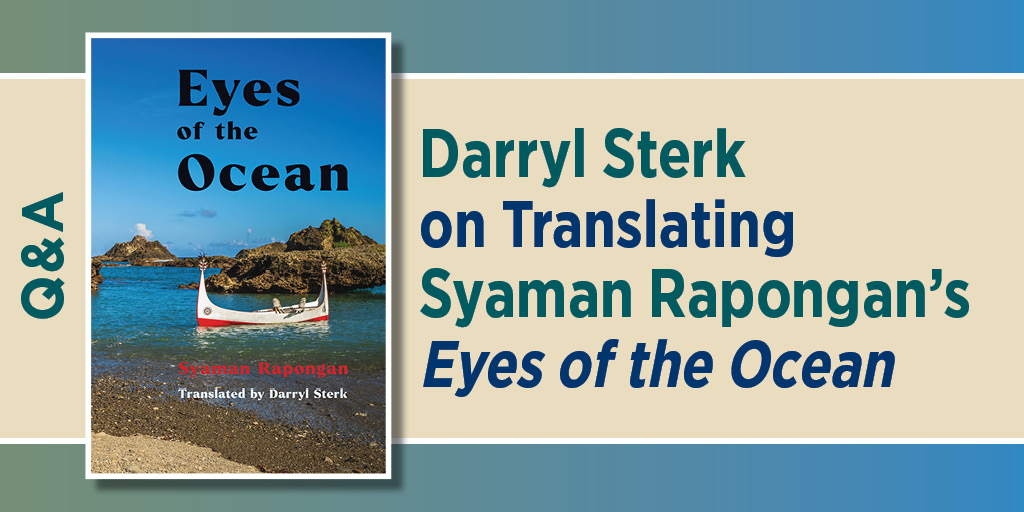
Darryl Sterk on Translating Syaman Rapongan’s Eyes of the Ocean
From The Man with the Compound Eyes to Ghost Town, I’ve translated a lot of literature written in Taiwan-style Mandarin Chinese over the years. Writers like Wu Ming-Yi and Kevin Chen may switch to Taiwanese, the local variety of Southern Hokkien, on occasion, but when they do I can ask my wife, who speaks both Mandarin and Taiwanese, to help me understand. When I translate an Indigenous writer like Syaman Rapongan—whose name means “father (of) Rapongan”—who is Taiwanese in the sense that he was born in Taiwan, I can’t just ask my wife. The author’s mother tongue is a Formosan Austronesian language called Tao, which he claims he translates into Mandarin to reach a broader audience. Yet he also uses a lot of Tao words in his writing, starting with the title of his autobiography, Mata nu Wawa. According to the Mandarin title, this means Eyes of the Ocean, which is how I translated it; I’m very happy that the English title is rhythmically similar to the original. I hope “eyes of the ocean” sounds like a thought-provoking literary collocation, which is what mata nu wawa is in Tao. Its interpretation is up to the reader. There is no right answer. I’m sure you’ll come up with more answers after reading the book.
There is a distinct set of challenges that face any translator of Indigenous literature, in the sense of literature written by Indigenous minorities, around the world. The writer may not be a native speaker of the majority language in which he or she writes. Moreover, he or she may have been forced to learn the language at school or on the job. Resentment might result, as well as obscurity in expression, if the writer was indeed translating from their mother tongue. The writer might refuse to translate to some extent, using words or even phrases from the mother tongue in the middle of the text. To be up to the task, the translator has to be willing to get out of his or her comfort zone and get familiar with the linguistic and cultural background of the writer and the work. A lot of translators work from Mandarin to English, but none of them knows any Tao. It helped in my case that I’d studied another Formosan Indigenous language called Seediq, but only to some extent. Tao felt like a whole new world. I was often at sea.
Tao felt like a whole new world. I was often at sea.
What I tried to do was fashion an outrigger canoe that the reader can row from Formosa, the main island of Taiwan, southeast to Pongso no Tao, the Island of People, where Syaman Rapongan is from. It’s also known as Orchid Island, but that’s a translation of the place name in Mandarin, the language of the colonizer. I ended up translating it both ways, with hints either in the text or in the footnotes or endnotes as to what the terms mean. I usually hint more than state, hoping the reader can meet the writer halfway. Given that Syaman Rapongan’s language is known as Tao, you can probably guess that tao in the name of his home island also means “people,” and pongso island. The no in Pongso no Tao is the same as the nu in the title of the book; as you’ve probably gathered, it means “of.” If you are able to make such discoveries on your own, that becomes part of the pleasure of reading. I took the same approach to common nouns. I initially gloss lalitan as meaning lava, but in the following sentence I refer to outcrops of lalitan. I was hoping that the reader would realize that lalitan includes both lava (and probably magma) and igneous rock like basalt or obsidian. In another passage, Syaman Rapongan is “solid as a cigewat,” a locution that I hope suggests “rock,” which is what cigewat, the author’s childhood name, means. As you row your way through the work, you’ll see the half dozen Tao words I’ve used in this little essay and more, and end up knowing a bit of Tao. Indigenous languages like this can become critically endangered, as young and even middle-aged people have switched to the majority or colonial language. I hope a few people get interested in Tao after reading my translation of this book.
Indigenous languages like this can become critically endangered, as young and even middle-aged people have switched to the majority or colonial language.
Beyond the language itself, I had the challenge of dealing with the vocabulary of indigeneity. Peoples like the Tao have been called savages, barbarians, aborigines, and, finally, Indigenous Peoples. In Canada they’re First Nations. In Taiwan, they were Mountain Compatriots, even islanders like Syaman Rapongan, just because the mountains were where such people lived in the bureaucratic imagination. “Compatriots” translates a word that implies that such people were part of the Chinese family, even born from the same womb. Portmanteaus or blends are a lot easier to create in Mandarin than in English, and there’s one in Taiwanese Mandarin that is basically “mountriots.” That wasn’t going to work in English, so I borrowed a word from Indochina, “Montagnard,” a fancy way of saying hillbilly. Such designations disappeared in the 1980s, when activists began using the term “aboriginal” to describe themselves. “Aboriginal” has since been replaced by “Indigenous”; the former stresses an ancestral tie to the land, the latter human rights. To adapt Hillary Clinton, Indigenous rights are human rights.
If readers feel uncomfortable with “Montagnard,” they could keep in mind that Syaman Rapongan did his college degree in French language and literature. That, I thought, justified the inclusion of a bit of French in the translation as well, including portière and, indirectly, À la Recherche du Temps Perdu. I can only hope that the words of my translation are like Proust’s “little crumbs of paper” that, when placed in water, “become flowers or houses or people, permanent and recognisable” in the reader’s imagination. Perhaps the people, places, and practices in Syaman Rapongan’s world might even spring into being from a cup of tea. In the author’s case it would be a bottle of HeySung Sarsaparilla, a root beer-like beverage that he spent a summer delivering in the days when he dared to dream of getting into college on his own merits, by taking the entrance exam. Passing it led him back home to Pongso no Tao and ultimately to a stellar literary career, in which Eyes of the Ocean is only one of many highlights.
Darryl Sterk is associate professor of translation at Lingnan University in Hong Kong, and the translator of Syaman Rapongan’s Eyes of the Ocean.
This website uses cookies as well as similar tools and technologies to understand visitors’ experiences. By continuing to use this website, you consent to Columbia University Press’ usage of cookies and similar technologies, in accordance with the Columbia University Press Blog Cookie Notice.