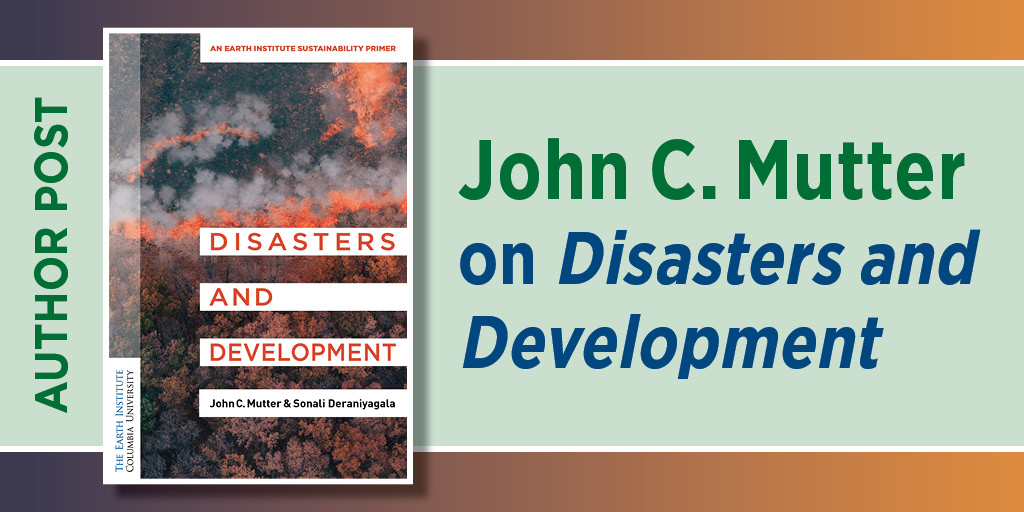
“What is the text book for this course?” is a question that came up every year we taught a course of the same name as our recently published book. Our answer was always that there isn’t one and likely will not be until we write one. That was usually followed by “So . . . ?” And so after procrastinating for years, we did. Here’s what we emphasize.
Disasters are nowhere near as simple as they are often portrayed to be. The stark brutality of the event belies the subtleties of their social causes and consequences. Disasters of equal geophysical magnitude have vastly different consequences in different socioeconomic settings. Poorer countries, for instance, experience far more fatalities than rich countries, although that in itself might not inhibit economic recovery. Richer countries, although they suffer greater losses of capital assets, are likely to recover more quickly. Depending on how recovery is achieved the results can even be beneficial in the long term. If damaged critical infrastructure, such as roads, ports, bridges, and airports, is replaced with improved facilities it can lead to more efficient systems that support commerce and stimulate the economy. If the reconstruction is funded by an agency such as the World Bank it can be thought of as a forced infrastructure upgrade of systems that had needed improvement but could not otherwise be funded. But without that sort of intervention, a disaster is more likely to be an economic setback, especially for a poor country and especially in the short term.
Disasters are nowhere near as simple as they are often portrayed to be. The stark brutality of the event belies the subtleties of their social causes and consequences.
Questions about disasters don’t fall comfortably into the domains of the natural sciences or the social sciences, although the former is mostly the way they have been studied. Natural scientists can quantify the risks: How likely is it that there will be a catastrophic shuddering of the Earth? Where might that happen? When? When and where will an immense cyclone occur? But natural science can’t tell us what the consequences of a disaster will be. That requires an analysis of economics, which is why we cooperate in teaching and writing to paint a comprehensive picture of disasters.
We emphasize that disaster events are not really events. The event is the centerpiece of a three-part sequence. First, we have to understand the physical and social conditions that prevailed before the disaster occurred. What, for instance, was the level of awareness that a disaster might occur? What was the state of civil society? In places like Myanmar most citizens have little notion that Cyclone Nargis could strike from the Bay of Bengal because the meteorologic services are so weak. Nor have they much sense of earthquake risk even though the Sagaing Fault, as seismically active as the San Andreas Fault in California, runs north-south through the entire length of the country. There are almost no working modern seismometers in Myanmar. In California there are thousands.
The event is the centerpiece of a three-part sequence. First, we have to understand the physical and social conditions that prevailed before the disaster occurred.
Often in hindsight, disasters can seem the inevitable consequence of poor governance. Hurricane Katrina, for example, evolved over decades, not days. Wetlands were compromised to facilitate the needs of the oil industry. Industrial canals were constructed to facilitate shipping, cutting through the poorest parts of the city. Their protective levees were poorly maintained. The city was divided in levels of poverty and wealth with richer people moving over time to areas less prone to flooding. They moved because they could; the poorer people had no options. The great majority of those who died or suffered displacement from Hurricane Katrina were poor African American people. One hundred thousand of those people who were displaced from New Orleans and wished to return were unable to for lack of resources.
Whether a cataclysm of the Earth’s solid structure or its atmosphere causes massive loss of life or very little depends critically on the country’s ability to quickly and effectively respond. We can see no strong evidence that democratic governments serve their citizens better than do autocratic governments in this regard. The response of the Chinese government to the 2008 Sichuan earthquake, entirely top down and directed from Beijing, involved rapid deployment of military assets. The response of the US government to Hurricane Katrina in 2005 was slow, incoherent, marred by red tape, and fumbled at city, state, and national levels.
Whether a cataclysm of the Earth’s solid structure or its atmosphere causes massive loss of life or very little depends critically on the country’s ability to quickly and effectively respond.
The final stage in the disaster sequence is recovery. How does a country get back on its feet amid ruins. The answer is highly variable. Some countries, like Haiti, are barely on their feet before disaster strikes. There are places that you can visit today and see the remnants of disaster damage from events that occurred decades ago. In others, after a few months you might not know that a disaster had taken place. Poor countries require external aid, but some poor country governments are not trusted to spend the aid wisely. Only a small fraction of money pledged to Haiti has been provided to the government. New Orleans is today smaller and racially whiter, with average incomes greater than before Katrina. But that is deceptive because of the diaspora of poor African Americans.
We include many case studies from across the world that interact disaster type with different settings—an earthquake in a poor country, a cyclone in a rich country, and so on—and examine causes and consequences. What emerges is that every disaster has its own unique stamp because no natural process ever repeats itself exactly and every setting is different.
John C. Mutter is a professor at Columbia University with appointments in the Department of Earth and Environmental Sciences and in the School of International and Public Affairs as well as a faculty member of the Columbia Earth Institute. He is coauthor of Disasters and Development: An Earth Institute Sustainability Primer.
This website uses cookies as well as similar tools and technologies to understand visitors’ experiences. By continuing to use this website, you consent to Columbia University Press’ usage of cookies and similar technologies, in accordance with the Columbia University Press Blog Cookie Notice.