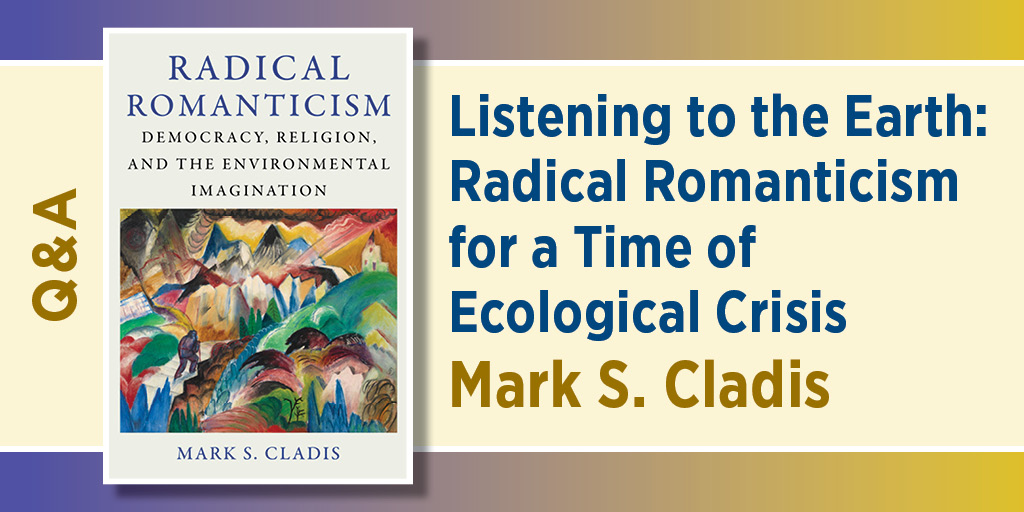
Each April, Earth Month invites us to reflect on our relationship with the planet we inhabit. The environmental crisis is not only a scientific or political problem; it is also a crisis of the imagination, a question of how we see the world and our place within it. In Radical Romanticism: Democracy, Religion, and the Environmental Imagination, Mark Cladis revisits the Romantic tradition through this lens. Moving from Rousseau and the Wordsworths to W. E. B. Du Bois, Zora Neale Hurston, and Leslie Marmon Silko, the book explores how literature, spiritual imagination, and storytelling shape our ethical relationships with one another and with the more-than-human world. In this conversation, Cladis reflects on the origins of the project and why Romanticism still matters in an age of ecological uncertainty.
One image from William Wordsworth’s Prelude captures the spirit of Radical Romanticism. In a dream, a man awakens in a desert and encounters another figure holding a strange object: a book shaped like a shell. When he lifts it to his ear, he hears not ordinary speech but “a loud prophetic blast of harmony”—a mysterious sound foretelling destruction to the children of the earth by a coming deluge. What kind of book is a shell? What kind of warning does it carry? The writers Cladis studies—from Rousseau and the Wordsworths to Du Bois, Hurston, and Silko—invite readers to listen for something like that shell-book: a form of literary imagination that sounds both warning and hope, helping us attend more carefully to a world marked by beauty, injustice, and ecological peril.
Q: What first inspired you to write Radical Romanticism?
Mark S. Cladis: Looking back, the path feels almost inevitable, though chance played its part. My early work focused on Émile Durkheim, whose thought opened questions about community, tradition, and the limits of the self-sufficient individual—questions that remain central to this book. Later, while writing about Rousseau, I began to see how critiques of social inequality were entwined with reflections on humanity’s relationship to the natural world. A turning point came during a research trip to the American Southwest with the poet Paul Kane, where we studied with two Indigenous educators, Lorrain Fox Davis and Ben Barney, who taught us to think about land as storied and to think about community as a practice of accountability. Their teachings helped me see Romanticism differently—not as an escape into nature but as a tradition deeply concerned with ethical relationality: to the land, to history, and to one another—including the more-than-human.
Q: The title uses the phrase “radical Romanticism.” What do you mean by that?
Cladis: The word radical carries two meanings that matter here. First, it refers to roots—to the deep sources of Romantic thought rooted in particular places, traditions, and communities. But it also signals critique. Writers such as Rousseau, the Wordsworths, Mary Shelley, and Henry David Thoreau were already grappling with the upheavals of modernity: inequality, industrialization, and estrangement from the land. When their insights are placed in conversation with later voices such as Du Bois, Hurston, and Silko, Romanticism appears less like nostalgic nature writing and more like a living and demanding ethical tradition. Radical Romanticism names a mode of imagination and dwelling that encourages us to question domination, to attend carefully to the world around us, and to imagine more just and ecologically grounded ways of living together.
Q: Your book brings Romantic writers into conversation with figures like W. E. B. Du Bois, Zora Neale Hurston, and Leslie Marmon Silko. Why was it important to include them?
Cladis: Because they both extend and challenge the earlier Romantic tradition. Writers like William and Dorothy Wordsworth sensed that modern life was generating forms of alienation—from one another and from the land—but they could not fully see how those forces were entangled with racism, gendered injustice, and colonialism. Reading Romanticism alongside thinkers such as Du Bois, Hurston, and Silko invites the tradition to learn from perspectives shaped by those histories and forms of oppression. By placing these voices in conversation, Romanticism becomes less a closed European period and more an evolving ethical tradition shaped by many histories and struggles.
Q: You often describe imagination as an ethical force. How can imagination shape our moral and political lives?
Cladis: Imagination shapes how we see the world—what we notice, whom we recognize, the pasts we bear witness to, and the futures we can envision. Poetry, storytelling, and lyrical prose are not decorative extras; they train our attention, our very experience of the world. When we read writers like Dorothy Wordsworth, Mary Shelley, Hurston, or Silko, we enter a mode of perception that makes us more sensitive to the lives around us—human and more-than-human alike. That attentiveness is ethical because it changes how we respond to the world that enfolds us. The arts cultivate capacities such as praxis-oriented empathy, reverence, and relational awareness, and these are not merely private feelings but public, democratic capacities. Without them, how on earth are we to imagine and sustain a shared democratic, ecological way of life?
Q: Your subtitle brings together democracy, religion, and the environmental imagination. How do those ideas connect?
Cladis: For the writers I study, these spheres are deeply intertwined. Democracy concerns how we live together politically; the environmental imagination reminds us that our lives unfold within networks of human and more-than-human relations; and religion—understood broadly—cultivates forms of ethical attentiveness to those relations. Across the radical Romantic tradition, spiritual imagination animates ecological care and democratic practice and aspiration. Whether in Wordsworth’s sense of a living natural world, Du Bois’s prophetic spirituality, or Silko’s ceremonial understanding of land and community, these perspectives converge on a single question: How shall we live in right relation? Radical Romanticism suggests that answering that question requires attention to political justice, spiritual imagination, and ecological belonging all at once.
Q: Why return to Romanticism now, especially in a time of climate crisis?
Cladis: Romanticism first emerged during a period of profound upheaval: industrial expansion, colonial violence, and environmental degradation. And the very crises that shaped radical Romanticism remain with us today. What the radical Romantics understood is that ecological and political injustices are deeply intertwined, and confronting them requires more than technical solutions (important as those are). It requires transformed ways of perceiving, believing, feeling—of acting. Their work reminds us that the imagination can be a resource for critique and repair. At a moment when despair often feels reasonable—indeed, when our despair signals that we are paying attention—radical Romanticism calls on us to hold two truths in tension: the reality of ruins and the possibility of renovation. It asks us to remain attentive—to injustice, to beauty, and to the fragile work of sustaining life together on a wounded earth.
Q: What do you hope readers take away from Radical Romanticism?
Cladis: I hope readers come away seeing radical Romanticism not as a past era or curiosity but as a living, ethical conversation. The writers I study—from Rousseau, William and Dorothy Wordsworth, Coleridge, and Shelley to Thoreau, Fuller, Du Bois, Hurston, and Silko—treat imagination and lyric expression as ethical powers, showing how questions of beauty, justice, ecology, spirituality, and democracy belong to the same effort: reimagining how we live together in the world. If readers finish the book thinking more deeply about their relationships with others—human and nonhuman alike—and feel stirred to act with greater care and imagination, I would be delighted. At a time when ecological and democratic futures loom uncertain and frightening, literature, philosophy, and spiritual reflection offer something remarkably radical: practices of attention and solidarity that help us reimagine—and reshape—our place within a shared and living world.