Trump Plays Directly into China’s Version of Reality
Thomas Colley and Martin Moore
President Donald Trump thrives on unpredictability. One day he will warn the world that the United States is about to impose punishing tariffs. The next he will send American troops to depose a foreign leader. The one after he will threaten to attack the territory of an ally. It is as though he gets his oxygen from keeping the world teetering on the edge of his next pronouncement—or the next “Truth” he posts on his platform, Truth Social. Trump believes that his antagonistic, coercive diplomacy secures concessions for America and forces its partners to pull their weight (increasing their defence spending, for instance). If his ambiguous threats and arbitrary punishments disorient, confuse, and cow other nations, so his logic goes, they will increase America’s power.
Yet the real beneficiary is China because Trump’s belligerent, volatile, chaotic approach fits perfectly with the narratives that the Chinese Communist Party has been nurturing for years. For over a decade, China has pursued a systematic and global campaign to “tell its story well.” The hero of its story is the CCP, portrayed as an enlightened ruler that has brought order and prosperity to China and more recently to the world. In diplomacy it professes no desire to interfere with state sovereignty (providing its own is respected) and only seeks “win-win outcomes” through partnership and trade. Across state news outlets, social media, and even state-approved children’s bedtime stories, China brings peace and prosperity; its international investments through the Belt and Road Initiative are the benevolent Xi Jinping’s “gift to the world.”
In the CCP-constructed version of reality, the United States is the global villain. Washington is a militaristic, destabilizing international actor that seeks not partnership but subjugation. Its political system is not democratic but plutocratic (ruled for the 1 percent, not the 99). When it does not get its way internationally, it imposes it by force—be it in Afghanistan, Iraq, Libya, or more recently Venezuela.
Trump’s chaotic and coercive foreign policy has benefited Beijing because it so perfectly reinforces this CCP narrative. He makes Beijing look like an agent of order and the United States look like an agent of chaos. When he ordered the removal of Venezuela’s President Maduro by force, he substantiated the CCP’s long-held claims that the United States ignores international laws and norms. When he followed Maduro’s removal by declaring US control of Venezuela’s oil, he reinforced the Chinese government’s longstanding argument that the United States only ever intervenes for economic gain. When he refused to support new Venezuelan elections or the candidacy of the opposition leader María Corina Machado, he made it easy for the CCP to claim that the United States has never been interested in democracy or improving people’s lives—its motives are only ever “imperial” and “hegemonic.”
In the CCP-constructed version of reality, the United States is the global villain.
The CCP’s propaganda wins extend to domestic US politics too, where every street protest, ICE killing, or government shutdown reinforces Beijing’s claims that its political system brings stability and growth while US-style democracy brings dysfunction and division. In Trump’s reality, that disorder is a means to an end—an authoritarian-populist doom loop in which he portrays “American carnage” so that he can position himself as the country’s only savior. But for Beijing, it is ammunition for an alternative reality that it has been promoting enthusiastically: that China is now the preeminent force for global order and the “democracy” the world should emulate.
To many this may read as Orwellian Doublespeak—dictatorship = democracy. By most indicators—freedom of expression, judicial independence, individual human rights, repression of minorities—China is a world-leading dictatorship, not a world-leading democracy. Yet the CCP claims that, unlike the US, China’s political system is genuinely responsive to people’s needs. The party says that it maintains a constant dialogue with the public and is always sensitive to public sentiment. So even if Chinese citizens cannot vote for their leaders (apart from local elections where they can select from a clutch of party-approved CCP candidates), democracy with “Chinese characteristics” is superior to US democracy because the CCP actually represents the Chinese people.
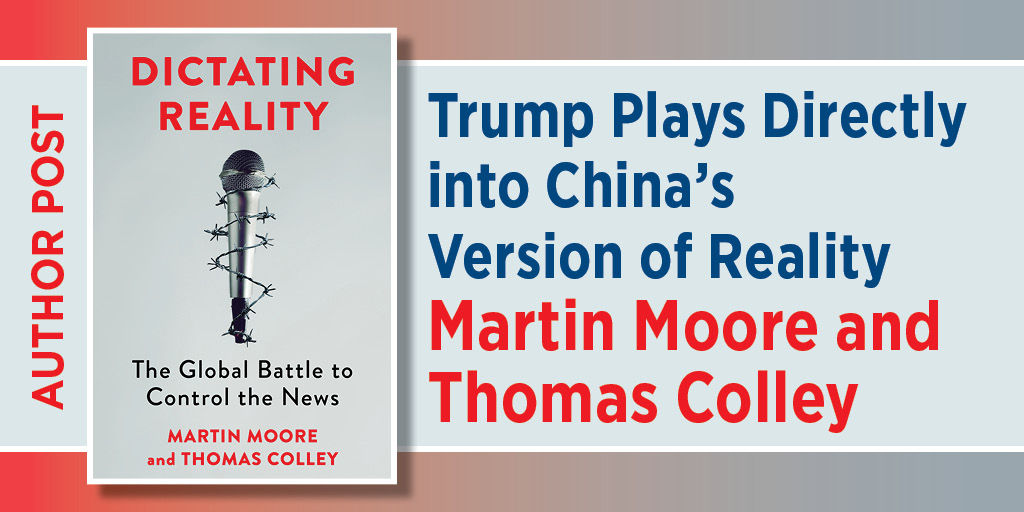
Since Trump returned to office, the Chinese government has grown increasingly confident in promoting this alternative reality thanks to its growing influence over international news. As we document in our book, Dictating Reality: The Global Battle to Control the News, for over fifteen years China has invested billions of dollars annually in the infrastructure of international propaganda. From cables to satellites, from investment in foreign news outlets to the establishment of foreign bureaus, China’s government has developed the pipes, the outlets, and the airwaves to stream its version of reality to the world.
China’s state news agency, Xinhua, claims to have over 10,000 journalists, working across over 180 offices outside China. The state’s international news broadcaster, CGTN, has 125 million Facebook followers. Each has signed content-sharing agreements with countries across the world to provide cheap or free access to Chinese news content. Turn on the TV in your hotel in Nairobi and you are more likely to find CGTN than CNN.
Trump’s chaotic and coercive foreign policy has benefited Beijing because it so perfectly reinforces this CCP narrative.
In contrast, Trump has gutted US international news services, defunding Voice of America and Radio Free Asia, outlets that have been previously promoted America’s perspective to the world. He has done his utmost to destabilize and discredit other democratic international news services, for example, in his current lawsuit against the BBC, the UK’s leading public broadcaster and one of the world’s most trusted news sources, including in America. Through these actions, combined with his antagonistic diplomacy, Trump is decimating US soft power—the ability to persuade and attract others—and leaving this tool of statecraft to the CCP.
The result of this is unlikely to be that global citizens start believing that China is democratic. But that is not the CCP’s priority. What it wants more—and appears to be achieving—is to minimize international criticism of its political system and its actions. Across much of the Global South, and indeed in the West, it is becoming increasingly rare to read news about domestic repression in China, human rights abuses in Xinjiang, or popular protests across China’s vast hinterland. People are more likely to read about the latest Trump threat or his latest slur about their country than news critical of Beijing.
Yet Trump risks giving China an even greater victory. One of the CCP’s longstanding aims has been to marginalize Western ideas like individual human rights, freedom of speech, and freedom of assembly in Chinese political discourse and international diplomacy. In showing open contempt for these values at home and abroad, Trump is giving China a bigger propaganda victory than the CCP’s often bland propaganda could ever have achieved by itself. In Trump’s reality he is making America great again. But in actual reality he is doing far more to make China great again.
Martin Moore is senior lecturer in Political Communication Education and Director of the Centre for the Study of Media, Communication, and Power at King’s College London. Thomas Colley is senior visiting research fellow in War Studies at King’s College London and senior lecturer at the Royal Military Academy, Sandhurst. They are the coauthors of Dictating Reality: The Global Battle to Control the News.
Categories:Author-Editor Post/Op-EdInternational RelationsJournalismMedia StudiesPolitics
Tags:AuthoritarianismBBCBelt And Road InitiativeCCP PropagandaCGTNChinaChinese Communist PartydemocracyDictating RealityDonald TrumpGlobal MediaGlobal OrderGlobal SouthHuman RightsInformation WarfareInternational NewsInternational RelationsMartin MoorePolitical CommunicationRadio Free AsiaSoft PowerStay InformedStrategic NarrativeThomas ColleyTruth SocialUS China RelationsUS Foreign PolicyVoice Of AmericaXi JinpingXinhuaXinjiang