If the European Novel Thinks Like a Person, the African Novel Thinks Like a World
Ainehi Edoro
In “Mr. Bennett and Mrs. Brown,” Virginia Woolf describes the act of writing fiction through the image of a chase. Reflecting on her own attempts at the novel, she recounts how a figure appears before the writer and calls out, “Catch me if you can.” She extends this image to novelists more broadly, suggesting that “some Brown, Smith, or Jones” draws them onward, so that they spend years pursuing this elusive presence, often capturing only fragments. Mrs. Brown possesses, she writes, “the power to make you think not merely of herself, but of all sorts of things through her eyes,” directing perception outward from interior consciousness. Character therefore operates as more than an element of plot. It is the organizing logic of narrative form. Woolf pushes this claim to its fullest articulation when she calls Mrs. Brown “life itself.”
As someone who grew up listening to African storytelling and later encountering African fiction as a reader and scholar, I have always felt a certain unease with this near-reverence for the individual as the constitutive logic of storytelling.
In Mrs. Brown, Woolf gives the modern novel a body through which we see it thinking like an individual. This post turns to African fiction to consider how a narrative might choose otherwise and instead think like a world. Many literary scholars today might recognize that the individual has become one of novel theory’s most overvalued narrative technologies. But African novelists have long worked from this understanding and created spectacular fictional worlds by giving voice and space to other beings, other domains, and other forms of power.
I have always felt a certain unease with this near-reverence for the individual as the constitutive logic of storytelling.
Nancy Armstrong, in How Novels Think, helps clarify why Woolf’s formulation holds structural weight beyond its moment. When Woolf claims that character is life itself, she names a narrative logic that developed alongside the European novel. Armstrong shows how novels evolved together with the idea of the modern individual, training readers to interpret desire through characters whose inner lives appear self-contained and socially legible. Over time, the individual becomes the device through which the novel organizes the world.
This orientation has rooted itself in Western storytelling practice. It has survived shifts in style and experimentation, persisting across modernist and postmodernist innovation, and resonates with broader philosophical and political traditions that treat the individual as the primary unit of thought, property, and citizenship. Writers like Kafka and Borges who strain against the logic of the individual reveal the force of their work precisely by confronting it.
In his 1984 UCLA lecture, Chinua Achebe raises an outcry for the ways that African fiction was judged for going against what he saw as an overestimation of the individual in Western literary discourse, what he specifically described as “the new spirit of individual freedom set off by the decay of feudal Europe and the rise of capitalism.” His message in that lecture was clear: The focus on the individual is not a universal necessity of the novel. It comes out of a specific European history defined by liberal philosophy and the political and aesthetic discourse around individuality that followed. Critics treated that inheritance as a formal standard and measured African fiction against it. Achebe exposes the limits of that position through satire, mocking what he calls “the very angel and paragon of creation—the individual hero,” a character so protected that even its destruction demands ceremony, justification, and soliloquy. He called out the ways that a regime of narrative protection easily slips into structures of political privilege.
The focus on the individual is not a universal necessity of the novel.
It is important to stress that this has nothing to do with diminishing individual freedom. Achebe anticipated this misreading of his rejection of the individual hero when he asked, “Does this mean then that among these people, the Igbo to take one example, the individual counts for nothing?” His answer is emphatic: “No. The Igbo are second to none in their respect of the individual personality.” Respecting the life of a person in the world differs from elevating an abstract ideal of the individual into a narrative device that anchors truth and governs visibility. The first carries ethical and political weight. The second reflects an ideological habit that, when applied uncritically, can narrow what a fictional world allows itself to register.
The individual, or the character, is of course a narrative convention. In real life, we understand that we are not the sole arbiters of our experiences, actions, or the world around us. We live within layered conditions where powerful forces and the lives of others continually interrupt and displace any pretense that we serve as the organizing principle of the world. Today this awareness registers even more sharply through digital technology, where our relationship with something like social media unfolds through a web of forces we cannot fully grasp or control.
My argument is that African fiction offers an archive of techniques for making sense of these complexities, revealing the web of forces in which the individual participates rather than governs. My colleague Cajetan Iheka calls this distributed agency, noting how the African fiction he studies treats something like ecological and material environments as animate presences exerting pressure on events. Human figures orient themselves within multispecies fields where meaning is anchored on the interaction with land, animals, climate, and matter as active participants in narrative life.
My argument is that African fiction offers an archive of techniques for making sense of these complexities, revealing the web of forces in which the individual participates rather than governs.
Let’s return to Mrs. Brown and consider why, if she were placed in an African novel, she could not be equated with life or given the power to control the entire narrative. African writers understand the many ways the world presents itself as complex and unstable, and rather than simplifying that complexity through the interior lives of characters, African literature has long functioned as a radically experimental space for developing diverse techniques for examining this complexity, bringing that generative multiplicity into storytelling.
African fiction centers spatial and cosmological frameworks in which no single figure can serve the function of filter. Built on indigenous models of space as layered, recursive, and entangled, African narrative worlds are structured through the coexistence of multiple orders of being—ancestral, spiritual, material, ecological, and historical—that are active within the story space.
Meaning does not converge in a sovereign subject because the world already contains other agencies, temporalities, and causal logics. Characters participate and exert their own pressures within these systems, but they do not stabilize them. Narrative validity arises through dynamic interaction among forces, what Achebe, in that same lecture, calls the “powers of event,” those “repositories of causes and wisdoms” that exceed human intention.
That is why, for example, African storytelling, from oral epics to modern fiction, is sensitive to questions of scale. A single character may move across dimensions that range from the household to the street, the forest, and ancestral realms, then back again. Characters are continually displaced into other worlds. Sometimes displacement can take the form of something as small as the meaning of a name, a ritual gesture, an encounter, a dream, or a walk to the market that suddenly shifts spatial orientation. You see this in classics like Amos Tutuola’s The Palm-Wine Drinkard and Ben Okri’s The Famished Road and also in works such as Ama Ata Aidoo’s Our Sister Killjoy. World thinking names a form of imaginative freedom, a narrative intelligence attuned to moving beyond the human as the sole threshold of meaning. In these stories, humans do not hold exclusive access to knowledge. Knowledge may arrive through ancestors, environments, or other beings or through worlds sedimented in space, flora, and matter. African writers have developed spectacularly rich archive of figures, narrative devices, rhetorical logics, and more that allow these presences to speak.
African fiction centers spatial and cosmological frameworks in which no single figure can serve the function of filter
This orientation does not belong solely to mythic or experimental writing. Even in novels often categorized as realist, including Pepetela’s Mayombe or Chigozie Obioma’s The Road to the Country, space functions as an active, layered field where historical time, cosmological force, and collective struggle intersect, preventing the individual from serving as the sole ground of narrative meaning.
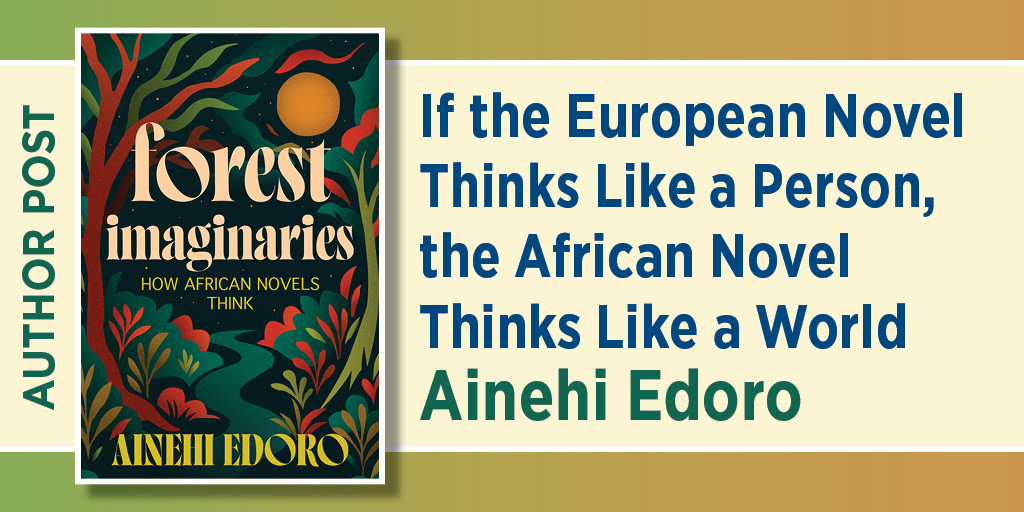
In my book Forest Imaginaries: How African Novels Think, I argue that this world-oriented intelligence is especially visible in the forest. Across African fiction, the forest is a site where large-scale systems, the abstract rules governing the legibility of worlds, are subject to world-building experimentations. It is a space of fragmentation and recomposition, where the dark underbelly of political power is exposed, cosmological logics are activated, and alternative forms of social life are imagined. The forest, because of its status as a threshold and sedimented terrain where history and nature intermingle, enables writers to think structurally about power rather than symbolically about character. It is a laboratory for world making.
African fiction values complex characters and richly developed interior lives. The argument here concerns emphasis rather than absence: Across its histories and genres, formal energy gravitates toward the design of worlds and the spatial logics through which power, knowledge, and life are organized. Even novels celebrated for their nuanced character work, such as Chimamanda Adichie’s Americanah and Teju Cole’s Open City, operate through sophisticated spatial logics, demonstrating how world design informs narrative meaning alongside interior experience.
Ainehi Edoro is a Mellon-Morgridge Assistant Professor of English and African cultural studies at the University of Wisconsin–Madison, and the founding editor of Brittle Paper. She is the author of Forest Imaginaries: How African Novels Think.
Categories:Author-Editor Post/Op-EdBlack History MonthBlack StudiesLiterary Studies
Tags:African literatureAfrican NovelAfrican StudiesAinehi EdoroBlack History Month 2026Chinua AchebeForest ImaginariesLiterary CriticismNancy ArmstrongNarrative TheoryNovel TheoryPostcolonial StudiesVirginia WoolfWorldbuilding