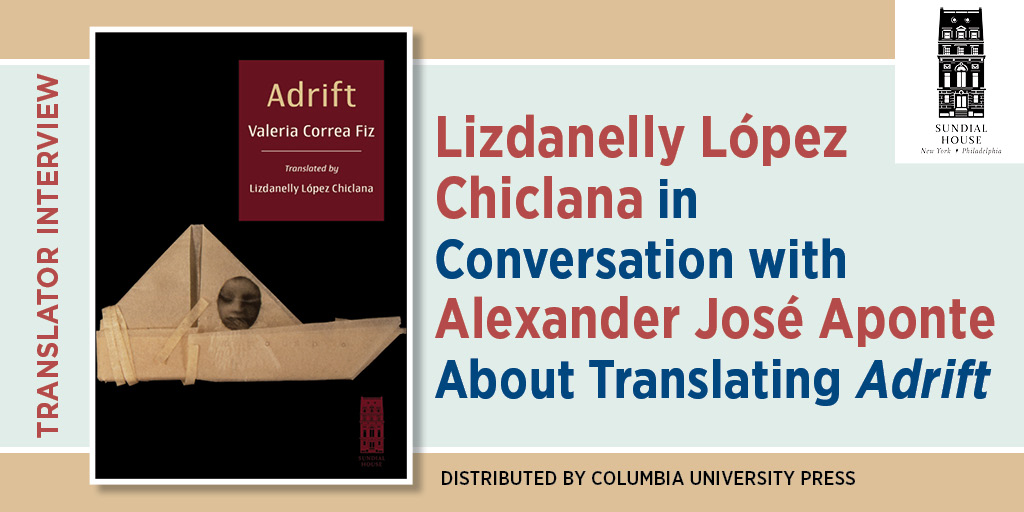
Valeria Correa Fiz’s Adrift is a collection of poems that move through exile, memory, and the body. For Lizdanelly López Chiclana, translating the book was both a challenge and a turning point. Her translation earned her a 2025 Sundial Emerging Translator Award and prompted questions regarding voice, language, and belonging. López Chiclana worked between Argentine Spanish and her own Puerto Rican experience, finding moments of connection and tension along the way. In conversation with her fellow Columbia student Alexander José Aponte, she explains what it meant to take on Adrift, how her background shaped her reading, and what she learned through the act of translation.
Alexander José Aponte: What was it like working on Adrift?
Lizdanelly López Chiclana: It was both invigorating and nerve-wracking. I honestly experienced the worst case of imposter syndrome. Diving into poetry was especially intimidating because I had always seen it as more difficult than prose to translate successfully. It was also very fun and intellectually challenging in new ways. My favorite part of the process was receiving the initial edits from the amazing editorial assistants that collaborate with Sundial House and seeing the project come to life.
Aponte: Was there a poem whose imagery or metaphors felt especially difficult or rewarding to translate?
López Chiclana: Yes, definitely—“The Wretched of the Soy.” Valeria and I met for the first time in Madrid this past June. She asked over dinner if it was too late to add two poems to the collection: “The Wretched of the Soy” and “Exile.” She advised that the latter would be complex and encouraged me to reach out with questions. The challenge I knew awaited me made this translation the most rewarding of the collection.
I found it most difficult to translate the title and ensure it encompassed everything Valeria was trying to convey. A close second was her recasting of the expression “diente de leche” (baby tooth), which in the poem refers to eyes instead of teeth. The most meaningful element is that it was the first instance where I exchanged questions and drafted verses with Valeria mid-process and got real-time feedback (instead of notes on a completed draft).
Aponte: How did you handle the cultural and political references in pieces like “American Dream” or “#Icantbreathe”?
López Chiclana: For pieces like “American Dream” and “#Icantbreathe,” I drew on my proximity to American culture and media, and my lived experiences with the United States as a second home. Translating “American Dream” reminded me of long summers in Miami and road trips through northern Florida; it was about channeling the imagery and emotions, but also bringing that which is so close to the heart to the page.
For “#Icantbreathe,” I approached the translation with particular care and respect. Telling this story required very conscious choices, like the capitalization of the word “Black” and translating “1 hombre de color” as “1 black man.” It was important to emphasize that the poem speaks to the Black community’s experience with police violence instead of casting a wider net. I sought to ensure that the translation aligned with the nuances of racial discourse in the sociopolitical context of the United States.
Aponte: Is there a moment in your translation that feels particularly yours, a line or image you’re proud of?
López Chiclana: I think it is difficult to draw clear lines between what feels particularly mine and what belongs to the poet. I have such a deep respect for Valeria’s work and had to remind myself that this is still, to some extent, my voice. From concepts like “a mistaken perspective” (in the poem “Vanishing Point”) to “their gesture of impending frost” (in “October Terrace”), these verses created struggles for which I had to invent solutions that felt most like my own.
Aponte: How did you navigate the shifts in voice and tone across such a diverse collection?
López Chiclana: I approached each poem in this collection as an individual entity. While there are clear underlying themes, each poem engages them from a different angle. My goal was never to push uniformity or enforce continuity. It was not particularly hard to deal with shifts and tones because I allowed each piece its own poetic voice. Valeria was very purposeful when curating this collection, even down to its later additions, which made my job much easier.
Aponte: Did your own background or experiences shape how you approached this translation?
López Chiclana: Of course! As a Puerto Rican, my background helped and challenged me in vastly different ways. As a colonial subject of the United States, there is a forced proximity to American realities that made it easier to translate poems like “American Dream.” Nonetheless, while Valeria and I share a language [Spanish], we speak different dialects and come from different cultural contexts. There were a few times in which I was stumped by her Argentine Spanish and needed to do a little dictionary deep dive to make sure we were on the same page.
Aponte: What does Adrift mean to you personally, as a translator or a reader?
López Chiclana: Adrift marks a culmination and a starting point. During my first year at Columbia, I was a part of a conversation in my Literature Humanities class on different translations of The Iliad that captivated me. I was interested in how different translations shaped the way we read and understood a text. Eventually I began working as an editorial assistant for Spanish to English translations and have been a student in various translation courses at Columbia. Fast forward to now, and I am publishing my first full-length translation project, something freshman me would’ve never imagined.
As a translator, Adrift allowed me to share Valeria’s beautiful verses with a new community of readers—a literary contribution of which I am immensely proud.
And as a reader, I have become more appreciative of the oftentimes invisible labor that goes into making every book I hold.