What Counts as Knowledge, and Who Gets to Recognize It as Such?
Isis Barra Costa
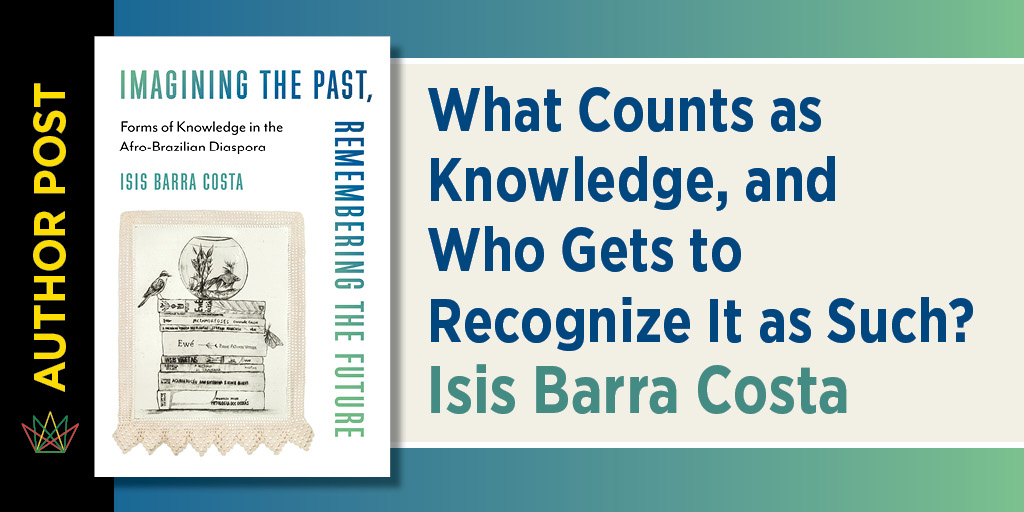
In Imagining the Past, Remembering the Future, I argue that Afro-Brazilian performances—chants, rituals, Carnaval processions, sacred inscriptions, spirit-dictated narratives—constitute complex philosophical systems that have long been misread as folklore, belief, or cultural residue. These forms do not merely represent knowledge; they produce it. They organize time, space, history, and community through embodied, sonic, and ritual practices that exceed the limits of the written archive.
It is often said that these archives must be made visible. But they have never been invisible. They are present, active, and shaping life across the Americas. The problem is not their absence, but our inability to read them. We have not been trained to recognize their languages, structures, and modes of transmission. We remain, in many ways, illiterate in relation to these forms.
The book moves between two worlds of knowledge that coexist but are not equally legible. The first part, shorter and more familiar, follows the architecture of European-derived disciplines—art, history, literature, law—forms we are trained to recognize and interpret. The second, more extended part shifts to a different ground, organized around Afro-Atlantic concepts that resist disciplinary classification. In this world, knowledge is structured through cosmologies, practices, and ideas—such as Mundiongo, Aruanda, Ìtàn, Dikenga, and Opón Ifá—that challenge how intelligibility itself is defined. The contrast is deliberate: it reveals not only what remains unread but also how our ways of reading have been shaped. The transition is not only thematic but methodological. It asks what happens when the frameworks that make knowledge legible no longer hold.
These forms do not merely represent knowledge; they produce it.
Translation, in this context, cannot be understood as a straightforward transfer between equivalent terms. Concepts such as “kingdom,” “religion,” or “literature” do not map neatly onto Afro-Atlantic frameworks; in Kongo-Angola, Yoruba-Ewe contexts, they carry distinct cosmological and political meanings. Even a crown, a stool, or an umbrella does not mean the same thing across contexts. A ritual is not simply a symbolic act; an oral narrative is not a lesser form of literature. Each term carries with it a history, a set of relations, and a mode of existence that must be understood on its own terms. To study these traditions is to learn how to move between epistemologies without collapsing their differences.
Afro-Brazilian knowledge systems often refuse the separations that structure Western disciplines. There is no strict boundary between sacred and secular, art and philosophy, aesthetics and ethics. A chant may be at once a historical archive, a philosophical reflection, and a form of healing. A performance may function simultaneously as memory, theory, and political intervention. Knowledge is not accumulated as static information but activated through practice, repetition, collective participation.
Knowledge is not accumulated as static information but activated through practice, repetition, collective participation.
In this book, I trace these forms across a wide range of cultural expressions, from Congada processions and Capoeira rodas to oracular texts and spirit-dictated novels. What emerges is not a collection of isolated practices but an interconnected diasporic philosophy. These traditions preserve and renew African cosmologies across time and space, creating a network of references that link Central and West Africa to Brazil and the broader Black Atlantic.
As a song by Maria Aparecida Martins reminds us, these are “histórias de gente ausente que se chama verdade” (histories of absent people that are called truth). These histories are not absent because they have been lost, but because they have been systematically excluded from what counts as truth. They persist in other forms, archives, and modes of transmission that demand different kinds of attention.
One of the central purposes of this work is to create bridges between epistemologies. This involves not only bringing Afro-Brazilian traditions into dialogue with dominant frameworks but also allowing them to reshape the terms of that dialogue. It means recognizing that these traditions are not simply objects of study but theoretical interlocutors capable of generating their own concepts, methods, and modes of inquiry.
They challenge us to consider that philosophy can be sung, that history can be danced, that archives can be lived.
This process also requires confronting the limits of our own training. As scholars formed within Western academic systems, we often rely on categories that obscure as much as they reveal. To engage Afro-diasporic epistemologies, we must learn to question these categories and to develop new forms of literacy attuned to embodied, performative, and relational knowledge. This is not a matter of abandoning rigor, but of widening the terms on which it operates.
At a moment when artificial intelligence is reshaping how knowledge is produced and recognized, and when institutions are rethinking canons, archives, and methodologies, Afro-Brazilian traditions offer more than new content to be incorporated. They propose different ways of knowing, remembering, and imagining. They challenge us to consider that philosophy can be sung, that history can be danced, that archives can be lived.
Imagining the Past, Remembering the Future is, in this sense, a modest contribution to a larger collective effort: to recognize, engage, and learn from Afro-diasporic knowledge systems on their own terms. It is an invitation to revisit what we think we know, to reassemble the present through other coordinates, and to imagine futures grounded in forms of knowledge that have long been present, even when we did not know how to see them.
This website uses cookies as well as similar tools and technologies to understand visitors’ experiences. By continuing to use this website, you consent to Columbia University Press’ usage of cookies and similar technologies, in accordance with the Columbia University Press Blog Cookie Notice.