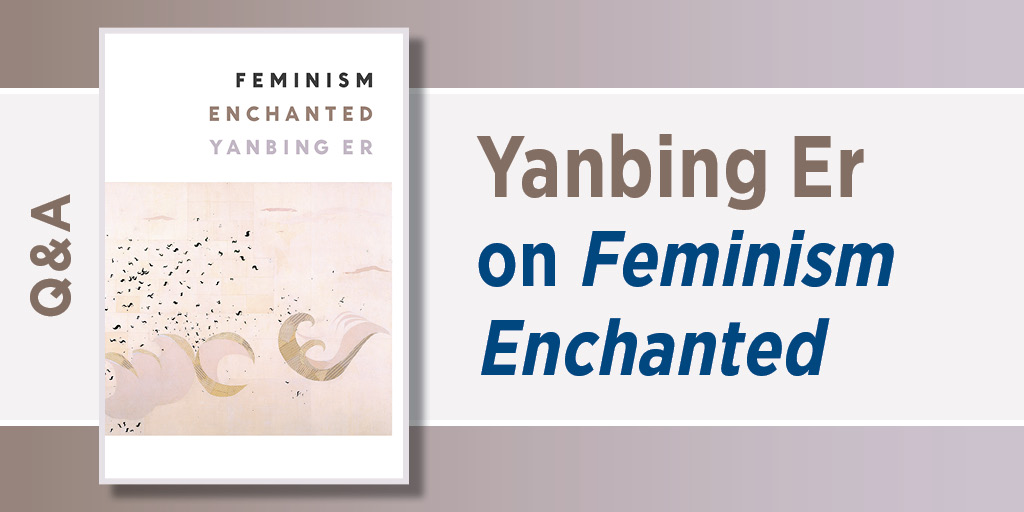
The feminist movement has long been guided by the promise of progress for women: politically, economically, and in personal life. But we live in a time when history appears to be moving backward toward a more reactionary past. How might feminist thought make sense of this plight without returning to the liberal, Western framework of progressive reason? In Feminism Enchanted, Yanbing Er argues that the key to this predicament lies in the capacity of the literary imagination to invigorate feminist critical practice. She reveals how a literary mode of enchantment can fundamentally transform feminist theory and praxis, imagining new and surprising possibilities that had once been foreclosed by dominant paradigms of progress. Enchantment illuminates forms of existence that have been lost, erased, or obscured, allowing us to encounter both feminism and the world anew.
Q: The idea of progress has been a formative one for the modern feminist movement. Why does Feminism Enchanted ask for us to imagine a feminism beyond the narrative of progress?
Yanbing Er: At the outset, it was important for me to make a clear distinction between feminist critical practice and a more pragmatic kind of feminist politics. While there will always be overlaps between approaches of “thinking” and “doing,” this book is primarily interested in dislocating progress from the former: Its main focus is on the question of feminist knowledge production. Feminism Enchanted does not call for an abrogation of feminist political progress, but rather prompts a reflection on the ways in which progressive reasoning has come to overdetermine how and what we know about feminism. What are the limits of progress as a dominant framework of feminist critique? Above all, what Feminism Enchanted invites us to do as scholars is to consider what we want from the critical methods we devise to comprehend not only feminism but also this world—methods that can and certainly will betray our hopes to bring about any semblance of progress toward another, better future. I see this not as a debilitation of critique but a radical expansion of what it can still do.
In the book, I also identify a more insidious side to the paradigm of progress. Although progress is inextricably linked to emancipatory ideals, especially in the context of feminism, it has also been synonymous with the historical project of European modernity and civilization. Which lifeworlds have been banished in the name of progress? Feminism Enchanted deliberately turns to these marginalized forms of existence to explore what kinds of feminist imaginaries might emerge if only we dared to think and theorize beyond these bounds of progress.
Q: Enchantment is framing concept for the book as a whole. What interested you about the term, and how is it engaged?
Er: Enchantment is a rich concept that has long been of great interest to a number of academic disciplines, including history, religious studies, literature, and more. I was initially drawn to enchantment because of its gendered connotations: for instance, we often think of the Homeric sirens, mythical bird-woman figures, as representative of a kind of enchanting and deadly power. But the cultural history of enchantment as a whole soon is fascinating to me, especially for its connection to certain gendered and racialized ways of living and being. Indeed, from the sixteenth-century witch trials in Europe to the ongoing settler colonial erasure of Indigenous spiritual practices around the world, the ideological power of disenchantment often has been wielded against diverse communities estranged from progressive modernity. What would it mean to resurrect enchantment at this time, not simply as a concept but also for its embeddedness in certain lived experiences deemed oppositional to the liberal modernity? The othered nature of enchantment formed much of the basis for my engagement with it as an idea.
I was also interested the manifestation of enchantment in an aesthetic encounter. We often describe ourselves as being immersed in the world of a literary text, for example. But what else happens at that moment? I don’t see this experience of enchantment as one of paralysis or inaction. At this instance, how is the assumptive logic of our lives made strange or rearranged to form something new? In its association with the marginalized lifeworlds detailed earlier, how does enchantment compel us to be receptive and curious to the alternative ways of thinking and knowing that they present? For me, enchantment became important to theorize as a very specific way of reading, and this is how I came up with the book’s operative term: its literary mode of enchantment. This mode of enchantment is employed throughout Feminism Enchanted to read feminism in order to understand it anew.
Q: What role does literature play in the book?
Er: I am first and foremost a literary scholar by training, and in many ways, this book challenged me to really reflect on the value of literature and literary inquiry today. Feminism Enchanted offers close readings of literary texts by Rivers Solomon, Akwaeke Emezi, Ruth Ozeki, Alexis Wright, and more, and I show how their works, varied as they might be, collectively allow us to inhabit a different kind of feminist imaginary.
But the book poses a much more encompassing question right from the very beginning: What is the imperative of literature in the context of feminist studies today? I argue that literary inquiry offers a pivotal means to reckon with what is newly at stake for feminist critical practice. At a time when feminist gains are actively being eroded, what modes of analysis can we still rely on to make sense of what is happening? It seemed to me that conventional frameworks of feminist critique were somewhat limited in their ability to respond to the current social order, and so I wondered if a more imaginative intervention would at least offer another kind of perspective. By reading Feminism Enchanted, I hope that feminist scholars return to, and begin to take seriously once more, the literary imagination as a key source of feminist knowledge production.