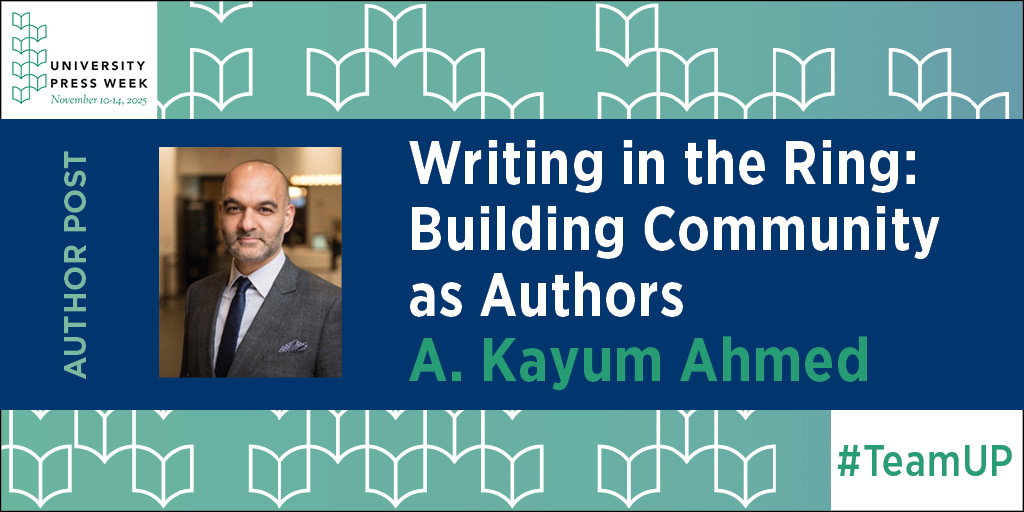
Writing a book can often feel like stepping into a boxing ring. As an amateur boxer preparing for my first (and last) match to raise money for cancer research, I’ve come to appreciate the parallels between writing and training: both demand discipline, repetition, and a certain willingness to be hit—by fatigue, by doubt, by failure—and still return to the ring the next day. Progress is rarely linear. Stamina matters more than power. And, perhaps most importantly, community—whether it’s coaches, sparring partners, or fellow writers—makes all the difference.
That sense of community is what I’ve found most rewarding in the Columbia University Press author meet-ups. Organized by series editor Alyssa Napier, these working groups offer authors in the Black Lives in the Diaspora: Past / Present / Future series a collaborative space to exchange ideas, build community, and reflect on how our research contributes to reimagining the Black intellectual and political traditions that shape the diaspora. Writing, despite being a solitary endeavor, is sustained through connection. These gatherings remind me that we are part of a collective struggle, each of us trying to translate our understanding and experience of the world into words that might move people to think and act.
Conversations with other new authors have been particularly grounding. Listening to what motivates them—the urgency of their subjects, the stories they feel compelled to tell, the desire to intervene in public debate—has reminded me that writing is not merely a professional undertaking but also a deeply personal and political one. It is an act of faith in language’s capacity to make sense of the world.
These gatherings remind me that we are part of a collective struggle, each of us trying to translate our understanding and experience of the world into words that might move people to think and act.
Equally instructive are the reflections of more experienced authors who have navigated the labyrinth of academic publishing and emerged, somewhat miraculously, intact. Their insights on negotiating the costs of academic publishing, applying for grants, and thinking strategically about audience constitute a form of collective wisdom rarely captured in handbooks. It is shared generosity, passed from one writer to another, to ensure that our work travels beyond disciplinary boundaries and reaches readers who might not otherwise encounter it.
What surprises me most is how my experience in the boxing gym has reshaped how I think about academia. Boxing is viewed as a hypercompetitive, testosterone-laden sport, and admittedly, there’s plenty of sweat and swagger to go around. But I’ve found that the boxing community, particularly at my gym in Harlem, is astonishingly collaborative. Fighters wrap each other’s hands, trade tips on footwork, and cheer each other on through exhaustion. Paradoxically, academia—and academic publishing—can feel far more brutal. The pressures to produce, publish, and perform can be relentless, often with little room for vulnerability or collective care.
That’s why I’ve deeply appreciated the author meet-ups organized by the very talented and kind Alyssa Napier at Columbia University Press, who has cultivated a space that embodies the spirit of collaboration I’ve found in the boxing gym. Her gentle facilitation reminds me that the best writing comes from community, not competition.
What surprises me most is how my experience in the boxing gym has reshaped how I think about academia.
Of course, writing remains hard. For me, this challenge is intensified by the fact that my book examines decolonial student movements, especially Rhodes Must Fall, even as today’s pro-Palestinian student uprisings unfold across campuses worldwide. The struggles I write about are not confined to history—they are happening in real time. Some days, the page feels too small to contain their urgency; other days, it feels like the only space where I can make sense of the situation.
In those moments of doubt, the Columbia University Press community offers a reminder that writing, like boxing, is never truly solitary. Each of us is part of a broader ecosystem of thinkers, activists, editors, and readers who make the act of writing possible. The exchange of ideas, the sharing of challenges, and the honest acknowledgment of how hard this work can be—all of it forms a quiet solidarity that sustains us through the long, uneven process of bringing a book into the world.
In the end, perhaps that is what writing demands most of all: not perfection, but persistence; not certainty, but community. And just as in the ring, we learn that the true victory is not in the knockout, but in showing up—again and again—with the courage to keep fighting for meaning.
Kayum Ahmed is a South African activist-scholar and previously served as CEO of the South African Human Rights Commission.
This website uses cookies as well as similar tools and technologies to understand visitors’ experiences. By continuing to use this website, you consent to Columbia University Press’ usage of cookies and similar technologies, in accordance with the Columbia University Press Blog Cookie Notice.