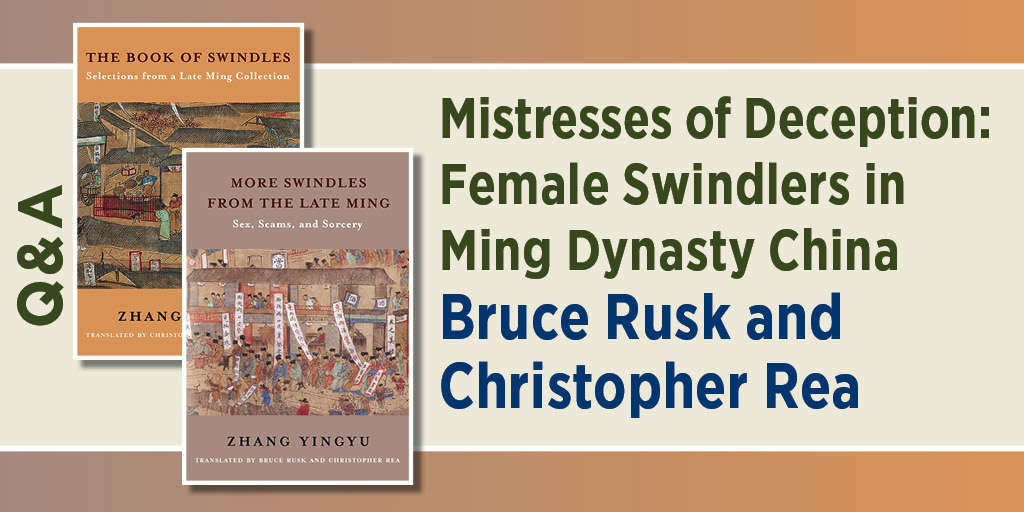
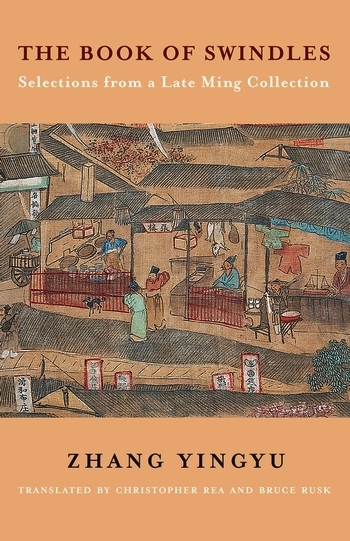
A woman seduces her landlord to extort the family farm. Gamblers recruit a wily prostitute to get a rich young man back in the game. A wealthy widow is drugged and robbed by a lodger posing as a well-to-do student. More Swindles from the Late Ming, the companion volume to The Book of Swindles, presents sensational stories of scams that range from the ingenious to the absurd to the lurid, many featuring sorcery, sex, and extreme violence. Despite late Ming society’s rigid gender expectations, Zhang Yingyu’s female swindlers find ingenious ways to exploit social roles and manipulate the norms meant to confine them. In this Q&A, Bruce Rusk and Christopher Rea explore how women perpetrated, subverted, and sometimes fell victim to the elaborate cons that flourished in Zhang’s criminal underworld.
Q: What kind of society do we find in The Book of Swindles?
Bruce Rusk and Christopher Rea: A world of stranger danger, especially in the realm of commerce. Or, for crooks, a world of opportunity. Zhang Yingyu’s stories are almost all about some kind of crime, trick, or subterfuge where someone gets the better of someone else—whether by guile, through violence, or with magical means. The perpetrator is most often after money, but some are driven by lust or revenge or just the thrill of a successful, clever ruse.
These cons were possible because late Ming China was a fluid society, with people, goods, and money moving over long distances. It was also a society with strong gender norms: most of the people on the road were men, and women were expected to stay at home. But in The Book of Swindles, which appeared in 1617, women are involved in many swindles, either as victim or as perpetrator.
Q: How do female swindlers show up in the stories?
Rusk and Rea: Because of the expectation that a respectable woman would remain within the household, there were fewer openings for female con artists to carry out scams. Women who did grift tended to be taking advantage of social roles that offered a little more freedom. One story features a female crook who plays the role of a young widow to drag a dull-witted mark into a trumped-up lawsuit and commits extortion (see “Marrying a Street Cleaner and Provoking His Death” in The Book of Swindles).
Female clergy living outside the normative family structure could also move relatively openly in public, and in Zhang’s world they are notorious as procuresses. In “A Buddhist Nun Scatters Prayer Beads to Lure a Woman Into Adultery” (Book of Swindles), the titular nun, Marvelous Truth, inveigles a proper wife out of her home and into a nunnery, gets her drunk, and thereby abets a seducer who on his own would have no way into the house of the object of his desire.
Q: Do these swindlers act alone?
Rusk and Rea: Rarely. In “Three Women Ride Off on Three Horses” (Book of Swindles), a team of female swindlers steal the mounts they have rented by giving their minder a well-orchestrated runaround. In other cases, a woman is a key part of a swindle perpetrated by a whole family. In “A Tenant Farmer’s Wife is Prostituted to Steal the Master’s Land” (More Swindles from the Late Ming), the wife of a poor peasant household seduces their landlord then blackmails him into signing over the deed to their land—with the aid of her husband and mother-in-law.
Those peasants are amateurs, however, compared to the family in “A New Concubine Is Kidnapped from a Boat at Night” (More Swindles): the young (but married) daughter of a professional swindler is set up as the second wife of an official, then seemingly vanishes as she accompanies him on his way to his new government post—her real husband has been shadowing their boat and secrets her away once the marriage has been consummated. The family ends up netting a double payoff: first a hefty bride price, and then hush money over the daughter’s supposed “disappearance.”
Q: What other roles do women play in Zhang’s stories?
Rusk and Rea: Women are sometimes harmed by swindlers, and sometimes are the prize the swindler seeks. Again, social position matters. In “A Fake Scion Rents Rooms and Robs a Widow” (More Swindles), the woman becomes head of household when her husband dies, but this leaves her vulnerable: the household of a widow is seen as an easy target. In another story, in More Swindles, a widow is the unwitting bait in a honeypot scam: the crooks pretend to represent her family and collect money from a prospective groom, giving the mark a well-timed glimpse of her in a temple.
Many scams involving women take advantage of a man’s wish for a wife, or simply his lust: typically, the stories present him as the “victim” and her as collateral damage. We have plenty of swindler-seducers too, not all of them men. The author, Zhang Yingyu, claims that women are wanton by nature and that their lust and passion is restrained only by social opprobrium. In his words, “Women are scrupulous about chastity for two reasons only: because they know shame and because they fear exposure. But once a woman loses her chastity, her sense of shame goes with it—and then she’s capable of anything” (Book of Swindles, 143). The misogyny of this comment is representative of Zhang’s bias, one that was widespread in his time.
Q: What more do the cons involving women reveal about Zhang Yingyu’s attitude toward women?
Rusk and Rea: We talk about this quite a bit in our introduction to More Swindles, in a section called “Family Relations, Familial Perversions.” The original book was divided into twenty-four thematic sections, and several of these focus on gendered relationships and give a prominent role to female characters: Marriage (type 16), Illicit Passion (type 17), and Women (type 18), as well as Pandering (type 24). The grouping together of the first three types suggests that these topics were all related in Zhang Yingyu’s mind, and that women were of special concern for him.
The stories in the original book are mostly written, however, from the perspective of an adult man. The advice Zhang gives is for a prospective husband—never a wife—and he never addresses female readers; he seems never to have imagined he would have any. Nonetheless, there are female characters whose remarkable character or cleverness inspires Zhang’s admiration.
Perhaps the most exceptional woman in The Book of Swindles is Miss Yau, the heroine of “A Marriage Scam of Passion Comes to Light Because of a Frog” (More Swindles). She is the victim of a long and violent con—after her first husband is killed, she is unwittingly (and reluctantly) re-married to his murderer. When the truth unexpectedly comes out, she becomes a paragon of righteousness, courageously confronting her second husband despite the rupture it will cause her family, including her sons by him. This story was already an old one when Zhang Yingyu wrote his version, which brought together the established genre of “biographies of virtuous women” (lienü zhuan) and the new genre of the swindle story.
As for female criminal masterminds, Zhang’s grudging admiration is best summed up by his comment at the end of “Three Women Ride Off on Three Horses”: “If even women can be such master swindlers, what difference is there between our world and that of the demons?” In short, The Book of Swindles is full of entertaining stories, but is hardly a source for critical or subversive views on gender relations!