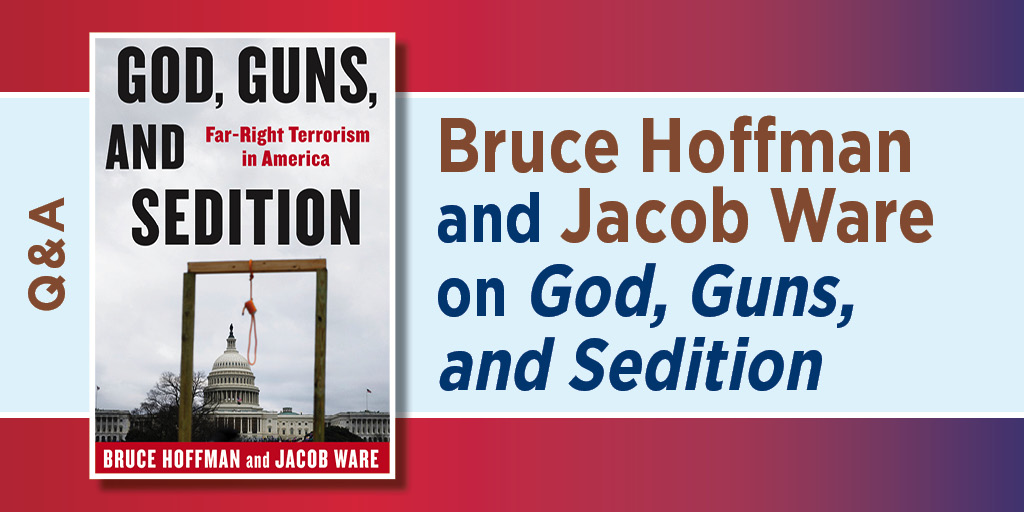
Shocking acts of terrorism have erupted from violent American far-right extremists in recent years, from mass shootings at places of worship in Charleston, Pittsburgh, and beyond, to a teenager who murdered his parents earlier this year in an effort to spark a race war. These incidents, however, are neither novel nor unprecedented. They are the latest flashpoints in a process that has been unfolding for decades. In God, Guns, and Sedition, winner of the prestigious 2025 Airey Neave Memorial Book Prize, Bruce Hoffman and Jacob Ware trace the historical trajectory of far-right terrorism in the United States and assess the present-day dangers of this violent extremist movement, along with the harm it poses to U.S. national security. In this Q&A, Hoffman and Ware discuss their writing process and offer insight into far-right terrorism.
Q: What drove you to write the book?
Bruce Hoffman and Jacob Ware: We began to write the book in April 2020 as the world shut down because of the coronavirus pandemic and we both burrowed into our home offices for the foreseeable future. The project was born out of a string of far-right terrorist attacks in the years immediately prior—from Charleston, SC, to Christchurch, NZ—and our firm belief that the violence was neither unprecedented nor novel but in fact part of a longstanding trajectory that began decades earlier. We also felt there was a need for a book that provided a full historical accounting of the American violent far right, from the establishment of the Ku Klux Klan in the aftermath of the Civil War to the modern terrorists who were attacking minorities and places of worship in high-profile mass shootings.
Q: Can you explain the title?
Hoffman and Ware: Although somewhat serendipitous, our book title refers to three defining eras of the American violent far right. In its origins, the movement took its inspiration from holy text. Early groups were often led by pastors and grew out of organized churches. In the 1980s and 1990s, extremists like Timothy McVeigh, the deadliest far-right terrorist in American history, were mobilized by fears of gun confiscations, shrouding themselves in Second Amendment–related justifications for violence. And more recent generations of violent far-right extremists have been driven by seditious motivations, intending nothing less than to overthrow the United States government—as was underscored by the seditious conspiracy charges successfully employed by the Department of Justice against several January 6 rioters (who were later pardoned by President Trump). Through its worship and pursuit of god, guns, and sedition, the violent far right has emerged into a leading national security threat to the United States.
Q: What was the most challenging aspect of the project?
Hoffman and Ware: The two authors of this book are forty years apart in age. The great challenge and great adventure was figuring out how to leverage each author’s unique experiences and advantages—Bruce as a historian with a wide-ranging knowledge of global terrorism, Jacob as a more social-media-fluent scholar at the same age as many of the subjects—to strengthen the narrative. For instance, our backgrounds helped tremendously in maximizing our archival work: for Bruce, delving deep into decades-old government reports and trial transcripts and for Jacob, trawling far-right forums for important signals in the rise of this movement.
Q: Can you tell us what you learned during the original book tour for the hardcover edition of the book?
Hoffman and Ware: When our book was first released, we were given the great opportunity to travel around the country on a book tour. It was tremendously revealing to visit different corners of our vast land and learn about how different enclaves were interested in various subjects. During our travels through California, we mostly fielded questions about the technology implications of our study. In Texas, audiences were concerned about what our findings meant for the First Amendment. And book talks in Canada revealed deep concern over American soft power and what far-right terrorism would mean for the US-Canada relationship. It was, of course, also tremendously enriching to have our ideas tested from each of these different angles.
Q: What’s the biggest misconception about far-right terrorism in America?
Hoffman and Ware: Because of the typology, the public and policy makers often assume that far-right terrorism exclusively targets the political Left. The reality could hardly be more different. In our book, we trace a long lineage of far-right violence that in fact targets other factors of the political Right—chiefly politicians who have bucked the orthodoxy—or other segments of society usually deemed more conservative, such as law enforcement or the US military. After all, arguably the most significant incident in our book, the January 6 attack on the US Capitol, primarily involved an assassination attempt on a conservative, Evangelical, Republican vice president (“Hang Mike Pence,” the crowd chanted). The violent far right is a seditious, antidemocratic movement—their success would see every American institution burned down, including the Democrat and Republican Parties alike.
Q: What are the future directions for far-right terrorism in America?
Hoffman and Ware: It remains to be seen. Many of the themes that we only began to tease out in the later segments of the narrative—from ideological convergence to youth radicalization—are now emerging as leading national security threats. Additionally, the return of President Trump to the White House has led both to resurgence in far-left terrorism as well as the possibility of far-right nonstate actors, convinced that they have executive branch “top cover,” engaging in vigilante violence or exacting retribution as some of those who were pardoned have vowed. It is the unfortunate nature of the American violent far right that such actors are particularly revolutionary both in their ideology and modus operandi. They are likely to keep us on our toes for the foreseeable future.