Lauren Taylor on Narrative Therapy with Older Adults
Each time I tell my story, I remove one small bit of hurt from inside me. I ease my wound. — Carol Staudacher, A Time to Grieve
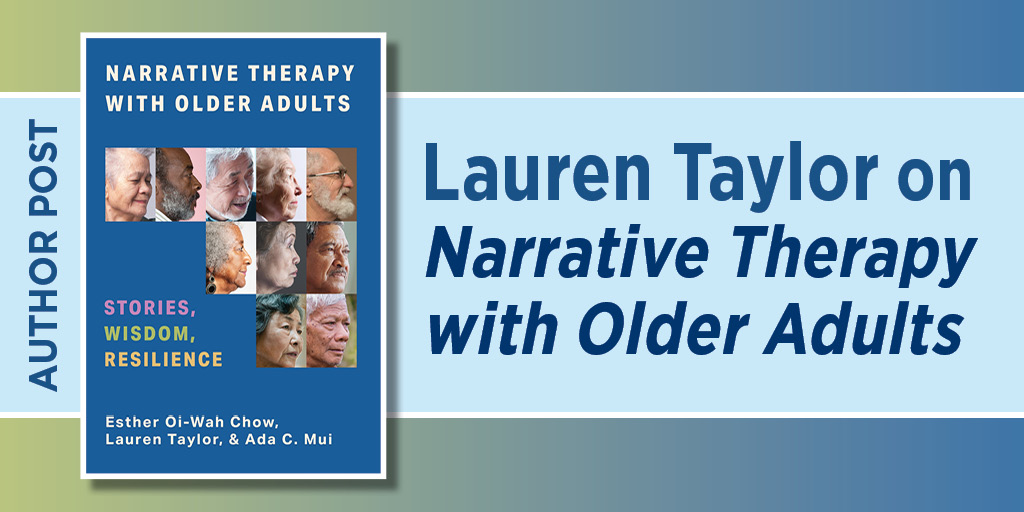
In Narrative Therapy with Older Adults, my coauthors Esther Oi-Wah Chow, Ada C. Mui, and I, worked together to illustrate the benefits of narrative therapy in different cultures, in research, and in the field. We demonstrate the power of this therapeutic tool in helping older adults make meaning of their lives.
Aging is a “problem” that most of us will come to know, but aging does not belong only to the old; it is a phenomenon that begins at birth. When we are young, we can distance ourselves emotionally and physically from the aging process. We may even think of aging as a communicable disease.
In this era of scientific research on aging, we often neglect the personal perspective, yet the need to tell stories is universal. Narrative provides us a lens through which to understand the subjective experience of aging. Only an individual can truly answer the question “What makes a life worth living?” We tend to favor the story with a happy ending, but the only ending of old age is death. In the words of François Mauriac, “Old age is marvelous . . . too bad it has to end so badly!” From time to time throughout my career, I was afraid to look through windows that opened onto my own aging. One day, a client said to me, “You can’t possibly understand what I am going through. You are young and I am old.” To which I replied, “Just stay right where you are, and I’ll catch up someday!” That was more than a quarter of a century ago, and I’m well on the way.
In this era of scientific research on aging, we often neglect the personal perspective, yet the need to tell stories is universal.
My involvement in narrative therapy grew out of my long career as a clinical social worker, practicing primarily with an older population. Much of my work as a clinician involves listening to life stories. In 2008, when Columbia University inaugurated the first Oral History Master of Arts program in the United States, I knew it would afford me the opportunity to pursue my passion for life story at the level of academic research. Over the course of my career as both clinician and oral historian I have heard hundreds of life stories. These stories were sometimes stories of suffering and despair, sometimes stories of joy and happiness, always stories of survival and resilience.
My skill as a therapist has helped me as an interviewer in establishing rapport, listening to trauma narratives, and intuiting when it is time to end an interview. My work involves bearing witness to the story, which is perhaps the most important part of what I do. Although I have led a privileged life in comparison with many of the people whose stories I hear, my training and experience have made me sensitive to the potential impacts of racial, ethnic, age, gender, and class differences between clinician and client, interviewer and narrator. Both spoken language and body language play important roles, for both the narrator and the listener. Working remotely since the pandemic has had a profound impact on this aspect of the process.
Aging sets us on a new trajectories. These transitions involve role changes for both the individual and the family. Aging is not an isolated event, but becomes a part of an older person’s story. It must be integrated into the life narrative, and understood in an individual, familial, and sociocultural context.
Aging is not an isolated event, but becomes a part of an older person’s story.
In his seminal 1998 article “Just Listening: Narrative and Deep Illness,” Arthur Frank speaks of stories as “relationships to be entered,”[1] rather than material to be analyzed. He describes three types of narratives, and puts each in a cultural context. The first, the “restitution story,” is the culturally preferred narrative of illness and suffering in North America. It tells of a suffering individual’s being restored to health through treatment. These stories lack the subjective experience of the client. The clinicians are the “experts” of the stories, and their subjectivities determine the outcome. When restitution is not possible, the narrator may turn to the second type of narrative, the “quest story,” in which the sufferer tries to learn something from the suffering, and that suffering takes on new meaning. We can tolerate that kind of narrative. The third, the type of narrative most feared in our society, is the “chaos story,” which cannot be told. As soon as the chaos story becomes a narrative, it is no longer a story of total chaos. Frank sees each of these types of narratives as pathways of entry into the therapeutic relationship. Clients come to us so intimately entangled with their problems that they may lose sight of themselves as more complete human beings whose narratives extend far beyond the immediate problem. The therapist works collaboratively with the client to create a new narrative based on resilience and strength. In helping clients uncover and appreciate their larger narratives, we assist in bringing deeper meaning to their lives.
My students often wonder about the skills they will need when they finish school. I tell them that the most important skill they have is to listen. As the French philosopher Simone Weil wrote, “The love of our neighbor in all its fullness simply means being able to say, ‘What are you going through?’”[2]
This website uses cookies as well as similar tools and technologies to understand visitors’ experiences. By continuing to use this website, you consent to Columbia University Press’ usage of cookies and similar technologies, in accordance with the Columbia University Press Blog Cookie Notice.