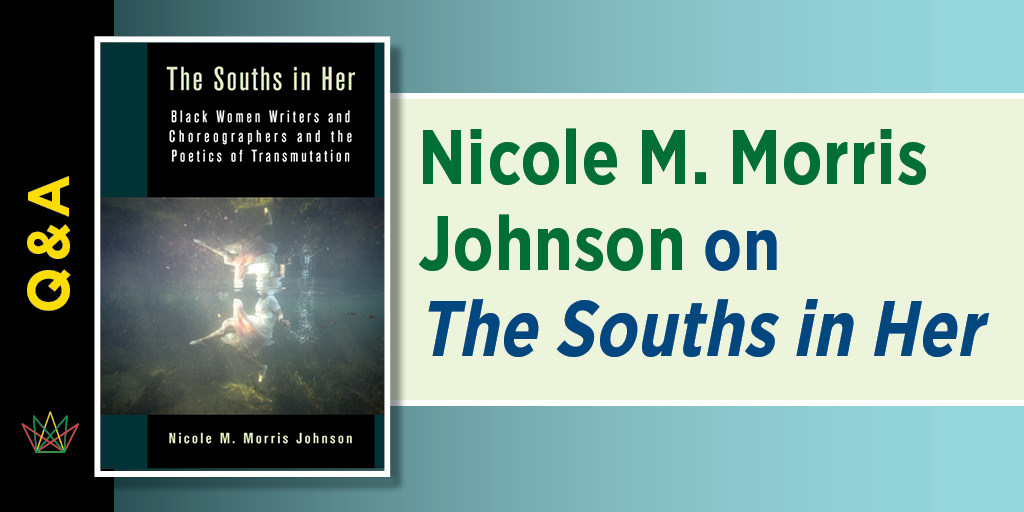
Throughout the twentieth century, Black women in the United States and the Caribbean were intellectually and creatively constrained in ways that were intimately connected with the Middle Passage. In The Souths in Her, Nicole M. Morris Johnson details the ways that writers and choreographers developed new forms of creative expression informed by the lived experiences and submerged histories of women across the Africana southern world. In this Q&A, she discusses the significance of the book’s title, the importance of considering multiple modes of expression to more fully understand Black women’s contributions, and how she is planning on extending the work of The Souths in Her in future projects.
Q: The pluralization of ‘Souths’ in your title is striking. Can you discuss the significance of this choice?
Nicole M. Morris Johnson: My use of the phrase “The Souths in Her” is inspired by a phrase that appears in Ntozake Shange’s 1982 novel Sassafrass, Cypress and Indigo. The novel centers the coming-of-age stories of three girls in Charleston, South Carolina. The girls’ mother uses the phrase “the South in her” both lovingly and exasperatingly to explain the audacious behavior of the youngest of her three daughters, Indigo. For me, the spirit of Shange’s use of the phrase – a commentary on the ways that southern spaces empower Black women to define themselves and their worlds – captures what I find when I examine Black women artists’ work. I pluralize the phrase because the writers and choreographers that I study move across a number of Souths including the US, the Caribbean, and West Africa. I also use Souths plural because the book considers the impact of the Souths not just as distinctive material geographies, but also as metaphor.
Q: Your pairing of writing and modes of movement, notably dance, is also unusual. Why did you look at Black women’s writing and choreography together, and what did you find that such a pairing revealed about Black expression?
Morris Johnson: Souths plural provides a vital lens for understanding the ways that Black women’s bodies become intertwined with ideas of ‘South’ from the time they exit the ships of the Middle Passage. Somewhat paradoxically, Black women moving is coded as evidence of primitivity rather than progression, and this is evident in the reception of Black women’s dancing as sexual and wild. We witness this in the reception of Black women who moved North during the Great Migration, and in the dance world where Black women’s bodies are not considered ‘disciplined’ enough or otherwise suitable to move in ways that are considered high art.
The entanglement between the Black woman’s moving body and notions of the South provides a basis for troubling ideas of Black women as primitive or as outside of the contemporary moment, perceptions that in turn lead to the exclusion or overlooking of Black women’s contributions to Black and American expressive cultures writ large. In examining writing and movement together, The Souths in Her recovers some of the often-overlooked expressive innovations by Black women that challenge these perceptions.
Q: How does a figure such as Zora Neale Hurston, who is now celebrated by a wide variety of readers, represent a bridge between dance or movement and writing—and does your book help us understand her importance today?
Morris Johnson: Many people don’t know how central performance—including dance—was to her interests. As Hurston moved from Florida to Maryland to Harlem in New York, she was attuned to how her body was being perceived by folks in the academic and arts worlds—perhaps before she even had a chance to open her mouth to speak. As she crisscrossed the southern US and Caribbean for her fieldwork, she also focused her attention upon what was communicated through the bodies of others, and how the stories she was encountering would be best shared onstage through dance and acting. Some of Hurston’s earliest staged work was not so different from the work of Katherine Dunham, who also staged dance concerts. Both artists centered Black dance in their theorization of Black performance.
Crucially, as I argue in the second chapter, Hurston comes up with a radical method for melding archive and repertoire that involves the creation of a foundational Black female folk hero. Through her ‘dynamic suggestion’ methodology, inspired in part by her encounters with unfamiliar cultural elements in Haiti that were capacious enough to include women’s insights, Hurston continues to inspire new work in conversation with her own that moves between the stage and page. Examples include work by choreographer Dianne McIntyre, who I had the pleasure of interviewing for the book; poet and playwright Mari Evans; and more recently the Memphis-based Collage Dance Collective’s ballet Their Eyes.
Q: Why does The Souths in Her matter now?
Morris Johnson: Metaphorical and physical Souths continue to influence Black women’s expression. Understanding the conditions that necessitated such a poetics in the first place is necessary for ensuring that Black women’s varied perspectives and contributions are visible and able to be considered in collective worldbuilding projects. We find ourselves politically and culturally in a moment where ideas intimately linked to Souths—including lost cause narratives and stereotypes about Afro-Caribbean people—are enjoying a resurgence. Simultaneously, curiosities about Africana religious practices and modes of resistance that we commonly associate as having roots in US and Caribbean plantation pasts are also growing in intensity. In response, scholars in fields such as Africana and the New Southern Studies continue to challenge intellectual frameworks to meet the moment, including those falling under the rubric of the Global South and the Black Atlantic. This includes important work from Regina Bradley, Riche Richardson, L. H. Stallings, and from my fellow authors in the Black Lives in the Diaspora series such as Jarvis C. McInnis, Isis Barra Costa, and Imani D. Owens. By drawing our attention to Black women’s poetics of transmutation, I am urging an ongoing awareness of the ways that Souths and their attendant stories continue to affix to Black people’s bodies and precede their expressive contributions. As we return to sites of narrative subjection and innovation, it is vital that we disrupt old organizing principles governing form, theory, and what Black physicality means that threaten to silence or significantly mute the insights of sizable portions of our populations.
Q: How will your future projects extend the work in The Souths in Her?
Morris Johnson: My future projects will continue to interrogate expressive frameworks. Focused primarily on Black women’s preservation methods, my next book will pick up on and extend many threads from my study of Hurston’s navigation of the archive and repertoire in chapter 2 of The Souths in Her.