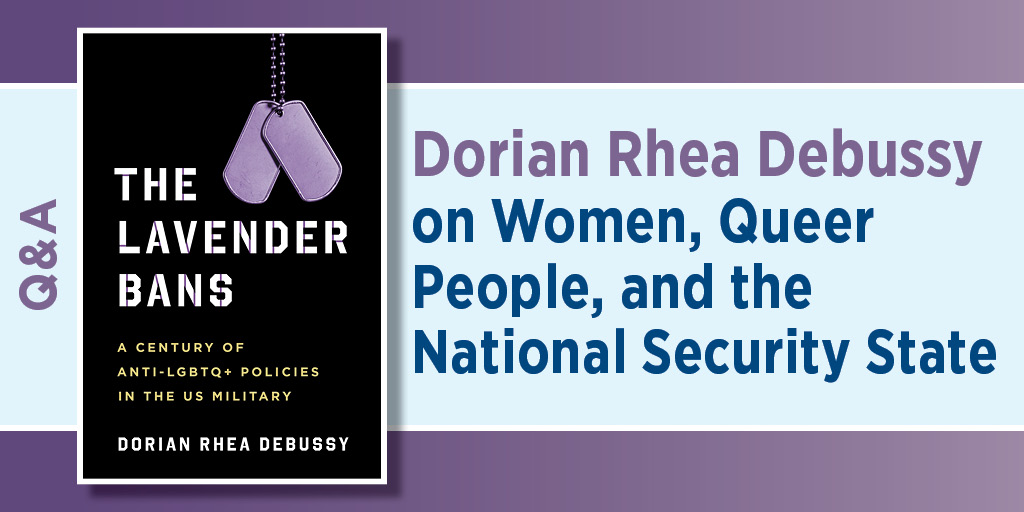
What is the impact of women and queer people on the national security state? In The Lavender Bans, Dorian Rhea Debussy traces the evolution of anti-LGBTQ+ policies in the American military and intelligence community from World War I to present. As she describes how these policies evolve over time, she also explores what anti-LGBTQ+ discrimination reveals about American political institutions. Throughout the book, her research tells the story of queer people who have shaped American military history. In this Q&A, she discusses what drew her to this topic, how women and queer people alike led change in the military and intelligence community, and how some iconic women like Judy Garland and Lady Gaga connect to this history.
Q: What inspired you to write The Lavender Bans?
Dorian Rhea Debussy: Like many authors, I draw inspiration from my own life and surroundings. My hometown of Columbus, Georgia is adjacent to Fort Benning, which is the largest infantry base in the country. In addition to familial connections to the military, I also have several friends—both LGBTQ+ and non-LGBTQ+—who have served. Notably, I was also living in Columbus when “Don’t Ask, Don’t Tell” was repealed in 2011, and that policy shift had an impact on people in my personal life, which eventually spurred me to explore the topic during graduate school at the University of Connecticut. From there, the topic just blossomed, and I uncovered a much larger history that went back far beyond the implementation of “Don’t Ask, Don’t Tell” in the 1990s.
Q: The 2026 theme for Women’s History Month is “leading the change,” and we’re interested in how this theme manifests in your book. Can you tell us about a woman who led change in the American military?
Debussy: There are several ways that this theme manifests throughout the book. But as an admirer of fashion history, Dorothy Shaver—who served as the president of fashion giant Lord & Taylor from 1945 to 1959—immediately comes to my mind. Shaver was one of the first women to lead a multimillion dollar business, and she also created Lord & Taylor’s “American Look” program to spotlight American designers and accessible styles throughout the 1930s. During World War II, Shaver consulted the US Army’s Office of the Quartermaster General, which resulted in women’s uniforms transitioning from impractical skirts and stockings to functional designs like field gear and pants.
Q: If someone peruses the index for your book, they may be surprised to find that Judy Garland is mentioned. How does Judy Garland—who is most known for her role in The Wizard of Oz—connect to LGBTQ+ history?
Debussy: That certainly is one of the more surprising items in the index, and it’s referenced in my discussion about shifting language during World Wars I and II. As I mention in the book, the phrase “Are you a friend of Dorothy?” was casually used in social settings to help covertly learn if someone was queer. Primarily used in gay male communities during the mid-twentieth century, the most commonly accepted origin story is that the phrase refers to Dorothy from L. Frank Baum’s Oz book series and its 1939 film adaptation, The Wonderful Wizard of Oz. But, there’s also evidence to suggest that this phrase may actually refer to gay-friendly soirées hosted by New York literary critic Dorothy Parker during the Roaring Twenties.
Q: Your book also focuses on LGBTQ+ people in the intelligence community. Are there any lesbian, bisexual, or queer women who led the change in that area of the national security state?
Debussy: There most certainly are, and one such woman is Julie Dubbs, who was a lesbian woman working for a defense contractor in the late 1980s. To perform her job, Dubbs needed a security clearance from the Central Intelligence Agency (CIA). However, the CIA actively denied her security clearance because of her sexuality. Ultimately, Dubbs challenged the CIA’s policy in federal court, but in 1989, the court denied Dubbs’ right to have the decision appealed. The discriminatory policy remained in place until 1994, when it was amended after the passage of “Don’t Ask, Don’t Tell” during the Clinton administration. While Dubbs may not have won the legal battle, she helped to showcase the impact of such outdated policies and their impact on national security.
Q: In the acknowledgments for your book, you mention some musical artists that helped you move through this project. Lady Gaga also makes an appearance in your discussion about “Don’t Ask, Don’t Tell.” Can you tell us more about how she connects to this history?
Debussy: I’m really glad that someone picked up on that. I’m very thankful for the albums that I enjoyed while writing and editing, and that’s particularly true of Margo Price’s Strays (2023) and Madonna’s Confessions on a Dance Floor (2005). That said, I do make mention of Lady Gaga in the main text of the book. In fall 2010, social and political forces were converging against “Don’t Ask, Don’t Tell,” which barred open service for queer people across all of the military’s service branches. Lady Gaga—who had only released one studio album at the time—became one of the most vocal celebrity critics of the military’s outdated policy. Following the release of “Bad Romance” less than a year prior, Lady Gaga used her growing online presence to mobilize her fans. Both online and in person, she urged them to call Congress and to demand that the policy be repealed. Ultimately, the “Don’t Ask, Don’t Tell” Repeal Act passed a few months after Lady Gaga’s public call to action, and her activism is very much tied into this history.
Q: Your research previously helped to overturn Trump-era military policies during the Biden administration. Now, your book comes at a time when the second Trump administration is actively discharging transgender people from the military. What lessons might your book teach us about this specific political moment?
Debussy: As an academic, it feels surreal to know that my research impacted national policy, but I’m thankful that my work was able to have a positive impact on transgender service members in the early 2020s. In terms of this political moment, history tells us that American political institutions are often resistant to change, but progress and social justice do prevail. While we’re seeing a contraction of transgender rights in this specific moment, history indicates that this, too, shall pass.



 African American / Black Studies / American History / Business / Feminist Theory / Film / Finance / Gender Studies / History / LGBTQIA studies / Literary Studies / Media Studies / Politics / Reading List / Science / Women in Business / Women's History Month / Women's Studies