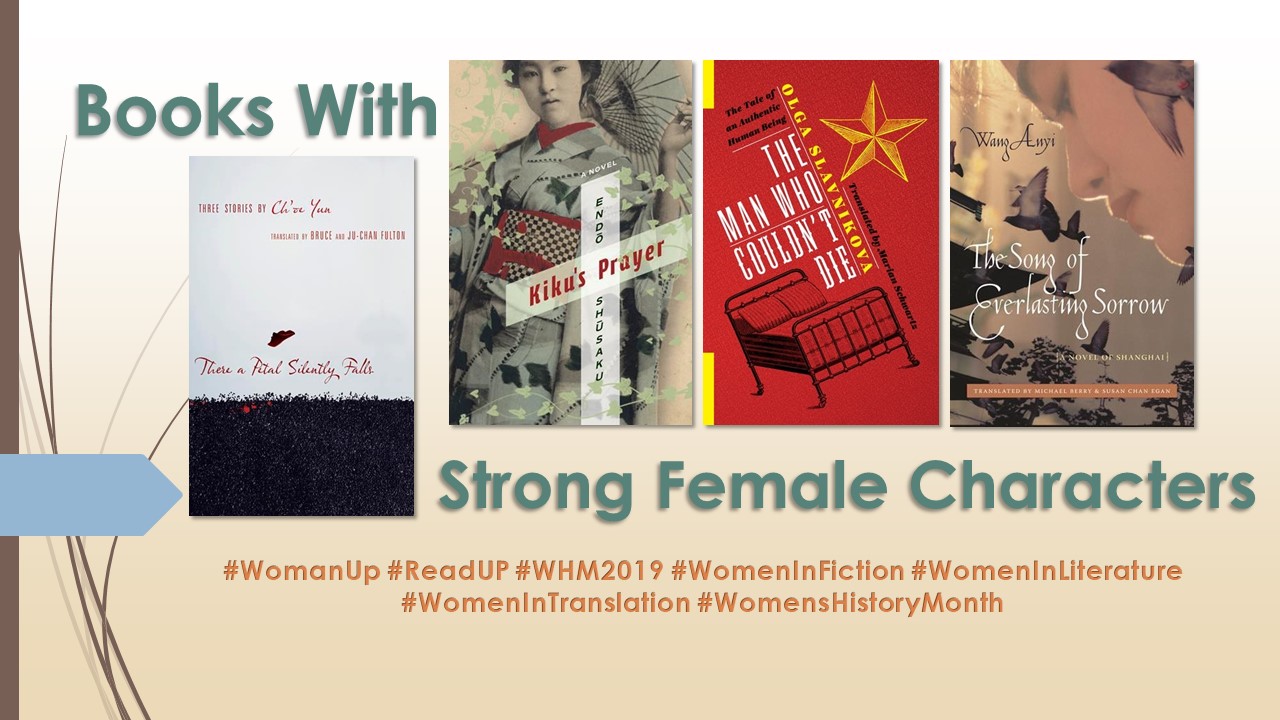
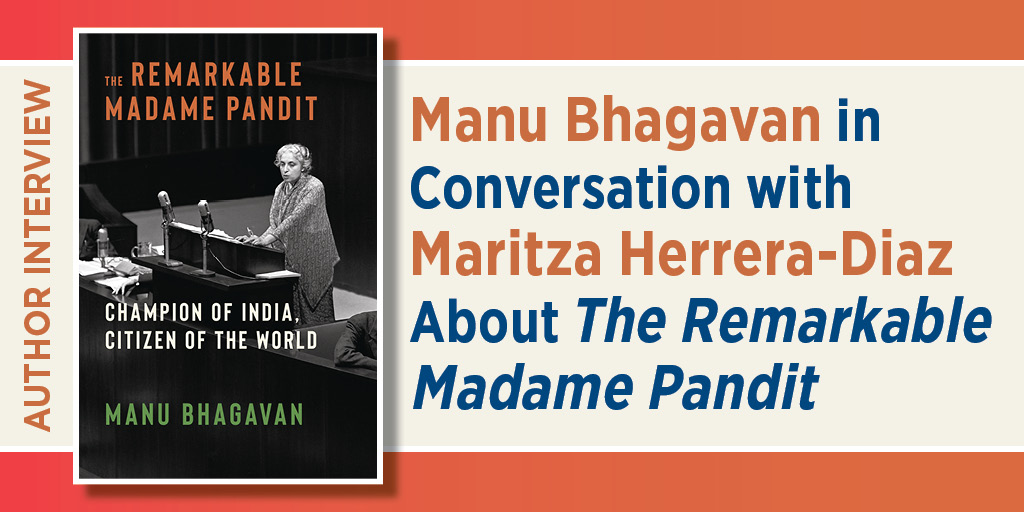
Vijaya Lakshmi Pandit (1900–1990) was a pioneering Indian politician and diplomat who played a central role in her country’s independence movement and in shaping the postwar international order. She was India’s first woman cabinet minister, later served as ambassador to the United States and the Soviet Union, and became the first woman elected president of the United Nations General Assembly. In The Remarkable Madame Pandit, Manu Bhagavan examines her life and career. In recognition of Women’s History Month, Maritza Herrera-Diaz, blog editor for Columbia University Press, discussed with Bhagavan her approach to leadership, her work in education and public health, the enduring significance of her global vision, and what made her a remarkable historical figure.
Maritza Herrera-Diaz: For readers unfamiliar with Vijaya Lakshmi Pandit and her global influence, can you tell us what made her “remarkable” and why her story still matters today?
Manu Bhagavan: Absolutely. Vijaya Lakshmi Pandit was one of the most important women of the twentieth century and India’s greatest diplomat. She helped shape much of the postwar world order even as she pushed for deeper and more meaningful structures. She was “the first” at almost every job she held, in one sense or another. She traded barbs and quips with Churchill and had a smoke with Mao. She was detained for the attempted assassination of Mussolini. Marlon Brando named her the woman he admired most in the world. Oppenheimer asked her for assistance in preventing nuclear disaster. She told Kennedy not to go to Dallas. And then, in her country’s darkest hour, she came out of retirement to stop an authoritarian takeover and save democracy.
And yet she is hardly remembered at all today. And therein lies the mystery of her story. How is it that one of the world’s most significant and powerful figures could simply be erased from memory? My book starts there.
Her story more broadly demonstrates how we have not yet to come to terms with the ways women/people of color/people from the Global South helped shape global institutions and norms. In learning about Madame Pandit’s life, we find that the story of the twentieth century—India’s and the world’s—is not the one we think we know. Her articulation of a democratic internationalism based on equality, justice, and respect, and a commitment to the neediest, all driven by the promise of human rights, may yet show us a way out of our current authoritarian moment.
Herrera-Diaz: Women’s History Month asks us to honor diverse forms of leadership. How does Madame Pandit’s story complicate or expand our understanding of what feminist leadership can look like across cultures?
Bhagavan: Madame Pandit was brilliant, beautiful, and charming. Her leadership style was ultimately based on friendly, but forthright, exchange. She never shied away from expressing her point of view or holding true to her values, even if this meant clashing with her brother; facing attempted marginalization by threatened, small men; or navigating dangerous political waters. Her infectious joie de vivre, generosity of spirit, and self-deprecating sense of humor put people at ease. People trusted her, which was quite an asset in the world driven by the high suspicion and paranoia of the Cold War.
She never liked it when people focused on the fact that she was a woman, because she felt that boxed her in and diminished what she was accomplishing. Yet she unabashedly advocated for women and women’s rights (while intersectionally standing at the forefront of racial justice causes and working for the eradication of poverty). She was very aware of patriarchal bias, detesting for instance media coverage that emphasized her clothes and fashion sensibilities. Yet she also did not shy away from embracing her own sex appeal when she saw fit. And she was a very early advocate for normalizing gay and intercultural relationships.
She basically saw beauty across cultures and value in everyone, even (especially) in those with whom she disagreed. At the same time, she maintained a moral clarity throughout her life and unfailingly opposed fascism, authoritarianism, racism, and other exploitative practices. This, to me, is really what made her stand out as a person and as a visionary leader.
Herrera-Diaz: As you were researching the book, how did your understanding of Madame Pandit and her leadership evolve? Was there anything that you found particularly interesting or surprising about her?
Bhagavan: Well, firstly, I was constantly surprised! She lived a long life, from 1900-1990, and appears at key moments all over the world throughout the twentieth century. And she seems to have connections to everyone: W. Somerset Maugham, Perle Mesta, Ingrid Bergman, J. Robert Oppenheimer, Margaret Sanger, Madame Chiang Kai-Shek, Marlon Brando, Mother Teresa, Frida Kahlo, Pearl S. Buck, Fiorello La Guardia, Allen Dulles, and the list just goes on and on. She maintained warm relations with so many, and so many kinds of, people, including those who otherwise did not get along with one another. She was extraordinary in this way, and it’s precisely why she was such an exceptional diplomat.
She features in my previous book, The Peacemakers, so when I started on this biography I felt that I knew her story quite well. I was shocked to discover how much more there was to it, how wide and deep her reach was. It was not just that she met or talked to all sorts of people, but that she was “in the room where it happened,” shaping policy and negotiating deals. She was, without question, one of the world’s most significant figures, heralded in her day as one of the two “greatest women in the world,” along with Eleanor Roosevelt.
Herrera-Diaz: Madame Pandit believed that lasting peace required social and economic equity. Can you tell us about some of her most successful contributions to education and public health and talk about whether those institutional frameworks are still in place today?
Bhagavan: Vijaya Lakshmi Pandit was elected to the Allahabad Municipal Board in 1936 and then to the United Provinces Legislature the following year, where she was immediately elevated to the rank of Cabinet Minister, holding the portfolios of Local Self-Government and Public Health. She became the first woman in the British Empire, after Margaret Bondfield, to have such a significant profile. In her earlier position, she chaired the Education Committee. So, to your question, she cared deeply about both education and public health and took her responsibilities to the people in these areas very seriously.
Aside from spot checks of local schools to directly interact with teachers and upend the corrupted systems in place, she quickly realized that most students faced impediments from hunger. To address this in the face of meager local budgets, she implemented a penny-collection drive to gather private donations to provide students with healthy milk. This turned into one of her first and most significant successes.
As Cabinet Minister, she battled a major cholera outbreak in her state, putting herself at risk as she raced from one affected area to the next, even as more than 15,000 people succumbed to the deadly virus. Through tireless efforts, she coordinated with state officials and local hospitals to increase vaccination rates and put other sanitary measures in place, forcing the disease into retreat.
We still feel the impact of her legacy in many ways. Some institutions with which she was associated—such as the Kamala Nehru Hospital, formerly run out her family’s ancestral home in honor of her late sister-in-law—still exist today in much larger form. Additionally, the principles she advocated for then have become the basis for expanded contemporary programs, such as midday milk and meal schemes.
Herrera-Diaz: Education played a central role in Madame Pandit’s vision for national and global progress. How did she understand education as a tool for long-term societal sustainability?
Bhagavan: She was uniquely positioned to speak to this question. She was widely respected for her deep reservoirs of knowledge and rhetorical prowess, handily defeating in debate some of the greatest lawyers of the day—including Sir Hartley Shawcross (a lead prosecutor at Nuremberg) and Charles Fahy (former Solicitor General of the United States)—for instance. She herself had been trained by private tutors only up to a certain level and had not attended university. But she read and studied relentlessly, ending up with honorary degrees from the University of London and Oxford, among others. Still, it was what she knew, not institutional pedigree, that led to her success, and she carried that view over to her prescription for societal betterment.
From the very start of her career, she focused on ensuring functional state delivery of basic education through primary school and evening classes for adult learners. At the same time, she criticized superstitions and misogynistic traditions that harmed women and contributed to discrimination. In short, she concluded that both formal and informal education—both schools and a lifelong commitment to learning—were needed to build up a society.
Herrera-Diaz: What do you hope readers will take away from Madame Pandit’s story—specifically with regards to leadership?
Bhagavan: I hope people will come away inspired! Madame Pandit led an extraordinary life and accomplished, well, remarkable things. But the book is not a hagiography. I hope I have been able to portray her in all her complexity. She faced many challenges, involving, for instance, mental and physical health and a widowhood that left her penniless at the behest of her husband’s family. It is not that she was superhuman that makes her great. It’s her humanness, and her humanity. She led by example. She was always authentic, honest, courageous, and empathetic. These are values all of us would benefit from in leaders today.



 African American / Black Studies / American History / Business / Feminist Theory / Film / Finance / Gender Studies / History / LGBTQIA studies / Literary Studies / Media Studies / Politics / Reading List / Science / Women in Business / Women's History Month / Women's Studies