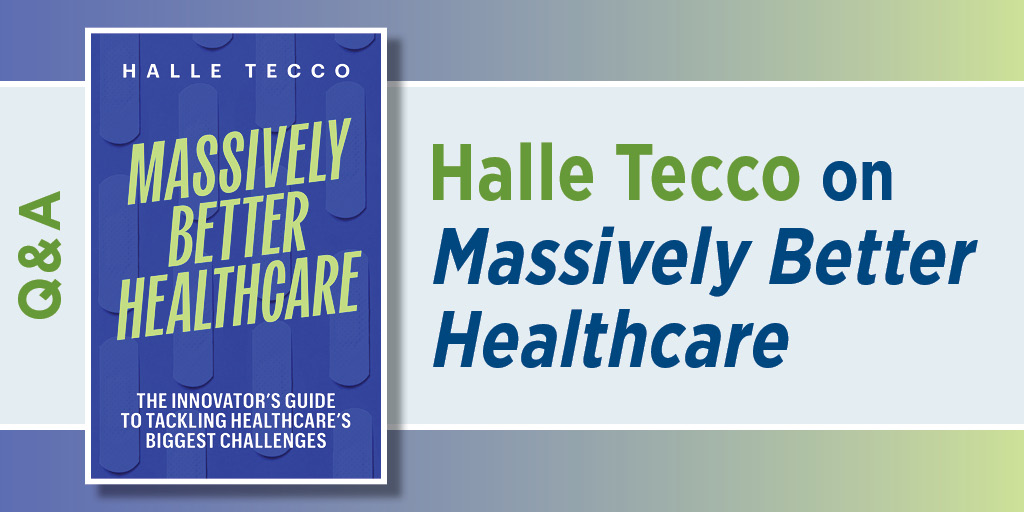
For decades, entrepreneurs and reformers have promised to “fix” healthcare, yet patients, providers, and payers alike remain frustrated by a system that seems resistant to change. In Massively Better Healthcare, Halle Tecco—a successful founder, an investor, and a professor at Columbia Business School—offers a new perspective on why progress has been so uneven and what it will take to build a system that truly works for people. Drawing on more than fifteen years of supporting startups, teaching at leading universities, and interviewing innovators on the front lines, Tecco explores how business models, incentives, and empathy can align to produce lasting impact.
Q: What inspired you to write Massively Better Healthcare?
Halle Tecco: The idea came from a mix of optimism and frustration. I’ve spent my career around healthcare entrepreneurs. These are people brimming with creativity, energy, and good intentions—yet I’ve watched how often their ideas stall once they encounter the realities of how healthcare actually works. At the same time, I’ve seen glimmers of progress: Founders are building companies that genuinely improve outcomes and experiences.
I wanted to understand what separates the breakthroughs from the dead ends. Writing the book gave me space to connect the dots and share all the best practices I’ve learned.
Q: The phrase “aligning mission and margin” runs throughout the book. What does this mean, and why is that alignment so critical?
Tecco: In simple terms, it means building models where financial sustainability and impact reinforce each other. Only when an organization’s economics are rooted in its ability to improve lives do we escape perverse incentives.
This alignment is critical because without it, progress doesn’t scale. A founder might build a product that improves outcomes or access, but if the economics don’t work, the impact will be limited to a pilot project or a small niche. Healthcare innovation has been littered with brilliant ideas that just couldn’t survive financially.
When mission and margin are aligned, everyone’s incentives point toward the same direction. A company earns revenue when patients improve their health or when clinicians spend more time on meaningful work.
In the best business models, money-making and mission-advancing form a virtuous cycle.
Q: What do you mean by being a “good steward of health data,” and why does it matter to innovators?
Tecco: Healthcare produces an ocean of data, but most of it is inaccessible—trapped in closed systems and cultures. Stewardship means attaining the greatest benefits from data while minimizing harm; this demands interoperability, privacy, and a mindset shift from hoarding to sharing.
Healthcare data breaches erode patient trust. Behind every data point is a person. If you wouldn’t be comfortable with your own health data handled that way, strengthen your protections. Builders earn the right to use data by safeguarding it.
Q: You’ve been both an insider and an outsider in healthcare. How has that shaped your perspective?
Tecco: When I founded Rock Health, I was very much an outsider—and I was treated that way. I was young, female, and from the tech and business world, which didn’t exactly earn me instant credibility in an industry known for hierarchy and gatekeeping.
However, I’ve come to realize that this outsider status was one of my greatest advantages. Healthcare doesn’t suffer from a lack of expertise; it suffers from a lack of fresh eyes and people willing to try new things. When you’re steeped in a system for long enough, it’s easy to stop questioning why things are the way they are. Outsiders don’t carry that baggage. They bring curiosity, creativity, and sometimes a necessary discomfort that can challenge the status quo.
In the book, I write about approaching healthcare with shoshin, or “beginner’s mind.” It’s the idea of staying open and curious, even as you gain experience. You can’t build better systems if you’re blinded by the way things have always been done. The goal isn’t to remain naïve; it’s to strike a balance between understanding and humility.
Ultimately, we need both insiders and outsiders. Insiders bring depth and context; outsiders bring perspective and possibility. The problem is that healthcare has often been too exclusive and too quick to dismiss new voices. If we want massively better healthcare, we need to welcome more people to the table—and be willing to learn from them, too.
Q: What do you hope readers take away from Massively Better Healthcare?
Tecco: I hope they come away feeling both informed and empowered. Healthcare can seem impenetrable, like a giant machine that only incumbents can influence. However, every person who touches healthcare, from entrepreneurs to clinicians to patients, has some form of leverage.
This book is about seeing the system clearly—how money moves, how decisions get made, and where incentives align or conflict—so that we can change it. I want readers to walk away empowered to do something: to apply the frameworks and case study lessons in their own work. Even small shifts in how we build, measure, or lead can create ripple effects. My hope is that Massively Better Healthcare gives readers both the context and the confidence to make those changes.