On Gaza Solidarity, Columbia University, and the Crisis of the Humanities
Wendell Marsh
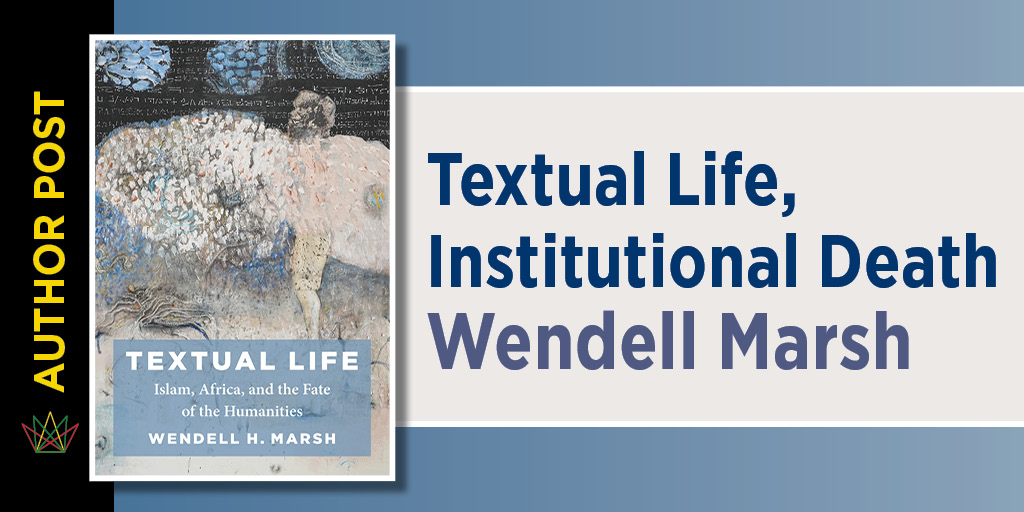
When I began writing Textual Life: Islam, Africa, and the Fate of the Humanities, I understood it as a scholarly intervention. It was meant to respond to some very academic debates about the interpretation of Africa’s Arabic written heritage. It read Muslim intellectual life in Africa on its own terms but in conversation with other traditions to trace the contours of a tradition too often misrecognized and to show how textual practices in Arabic, French, and Pulaar represent an enduring commitment to knowledge. Using the parable of Shaykh Musa Kamara, a wildly prolific but poorly known writer from colonial Senegal, I sought to show how African Muslim thinkers engaged questions of history, theology, language, and power. I also wanted to show how their texts offer vital resources for reimagining the humanities in the present. What I did not anticipate was that the world in which the book would appear would so closely resemble the one it described. We are living in a moment when the very conditions for humanistic inquiry are under siege.
The research and intellectual formation that shaped Textual Life took place in the Department of Middle Eastern, South Asian, and African Studies at Columbia University, where I completed my doctorate. MESAAS was not just an academic unit. It was a space where critique was more than a passing complaint. It was a method and a commitment. This meant the redescription of power taken as natural or normal to reveal the ways it has been embedded in empire, racial capitalism, and knowledge. That space made it possible for a young African American student from Atlanta with no real personal ties to the region to spend years immersed in African Islamic texts, think across geographies and genres, and develop a project that contributes to the decolonization of thought.
They resist being disciplined. They remind us that obedience is neither a civic nor scholarly virtue.
The actual writing of Textual Life would come later, though, when I was a faculty member in the Department of Africana Studies at Rutgers University–Newark. That intellectually vibrant department committed to Black life and thought provided me the space, support, and the spirit of urgency with which I could bring this book to fruition. These two institutional homes, MESAAS and Africana Studies, together made the book possible. And that’s the value of such critical fields: They resist being disciplined. They remind us that obedience is neither a civic nor scholarly virtue.
This virtue was tested with the scholasticide in Gaza. The term describes “systemic obliteration of education through the arrest, detention or killing of teachers, students and staff, and the destruction of educational infrastructure” according to experts affiliated with the United Nations Office of the High Commissioner for Human Rights. When students pitched tents in peaceful protest in front of Butler library in the spring of 2024, sparking the Gaza solidarity encampment movement, they highlighted that Columbia’s investments made the institution strategically located between knowledge and power.
Textual Life could not have been written under these conditions.
As a result of bold student action, Columbia University has become the epicenter of a political storm. In response to federal pressure and the suspension of hundreds of millions of dollars in funding, the university agreed to sweeping changes. These include placing MESAAS under administrative oversight, authorizing a special police force, adopting the IHRA definition of antisemitism (which conflates the critique of the Israeli government with antisemitism), and accepting the appointment of an external monitor with government input to oversee key university policies. Scores of students have been suspended or expelled for protesting the war on Gaza. Others, such as Mahmoud Khalil, were targeted for political detention. Faculty members have withdrawn courses in protest. The costs of intellectual honesty have rarely been higher.
But Columbia is only one front in a wider assault. We are witnessing coordinated attacks in this country on academic freedom, diversity, and critical thought. Right-wing politicians have demonized Black studies, banned critical race theory, and dismantled DEI initiatives at public universities. Curricula are being rewritten to erase the historical record of racism, settler colonialism, and empire. Entire disciplines are being cast as un-American or antisemitic. We are living through a new McCarthyism, though its targets now are those who study and teach from the perspectives of the marginalized, the colonized, and the dispossessed.
It is animated by the belief that the humanities matter not as a luxury but as a lifeline.
And that is precisely the point. The book is not simply an intellectual history. It is evidence of what becomes possible when departments like MESAAS and Africana Studies are allowed to do their work. It is a testimony to what can emerge when critical scholarship is nourished across institutions, when Black and Muslim intellectual traditions are taken seriously, and when scholars are given room to think and write beyond fear.
I do not write this as an elegy. I write this as a marker of a turning point. We are living in a time when Gaza starves, when students are criminalized for honoring their own humanity by taking a stand, and when faculty are punished for pursuing the truth. We are not only reckoning with empire abroad but also with militarism doubled back on itself at home, hollowing out civic institutions such as the university. The very departments and programs that we need most in this moment—the ones that offer alternatives to dominant paradigms—are under attack not because they have failed but because they have succeeded in challenging injustice.
We must refuse the narrowing of what can be said, studied, or imagined.
Textual Life was never intended to be neutral. It is animated by the belief that the humanities matter not as a luxury but as a lifeline. It is a call to take seriously the intellectual labors of African and Muslim thinkers. It is a refusal to concede the university to those who would trade critical inquiry for compliance.
At this moment of crisis, we must do more than defend individual students or scholars. We must refuse the narrowing of what can be said, studied, or imagined. And we must affirm the value of those programs, such as Africana Studies and MESAAS, that keep alive the histories and futures that the dominant power would prefer to forget. We must defend the conditions that make critical thought possible.
This website uses cookies as well as similar tools and technologies to understand visitors’ experiences. By continuing to use this website, you consent to Columbia University Press’ usage of cookies and similar technologies, in accordance with the Columbia University Press Blog Cookie Notice.