This year marks the fiftieth anniversary of the Helsinki Final Act (HFA), a document signed by thirty-three European countries, the United States, and Canada. Among the signatories were states that no longer exist, like the USSR and Yugoslavia, but their successor states adopted the HFA’s principles and joined the Organization for Security and Co-operation in Europe (OSCE), established in 1995. The HFA’s “decalogue” outlines foundational principles of international relations. These principles have been challenged by Russia’s war in Ukraine. If America and Europe allow Putin to prevail, it would legitimize territorial gains through violence, heralding a new world order of disorder and chaos, marked by competition and extermination rather than cooperation and solidarity.
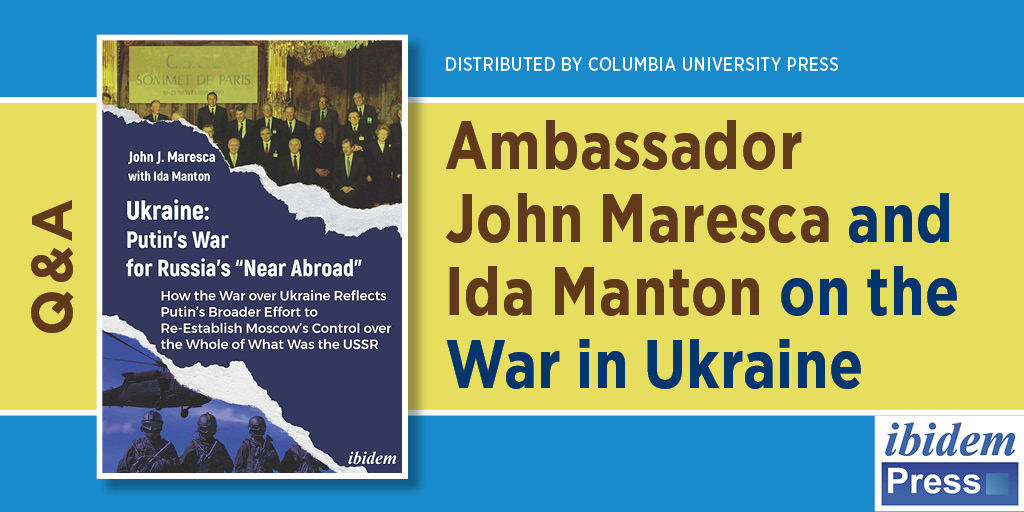
In this Q&A, the coauthors of Ukraine: Putin’s War for Russia’s Near Abroad discuss why the war’s outcome matters, propose solutions based on lessons from existing security structures, and argue that humanity has the knowledge and resources to do better by re-envisioning our future, prioritizing inclusivity, and preparing for a long transition.
Q: It is the fiftieth anniversary of the signing of the HFA. Why is this document still relevant today?
Ambassador John Maresca: It is still relevant today because our goals of full respect for human rights and peaceful relations between countries, which we have been pursuing through the CSCE and the Helsinki commitments, have not yet been fulfilled and there are still many places in the world where they are ignored. The commitments reached through the CSCE negotiations are important tools that give us the opportunity to discuss human rights with national governments, which have undertaken specific commitments under this general heading. As long as human rights are not fully respected by governments, the Helsinki Final Act and other, similar commitments will be useful tools for pressing governments to carry out their responsibilities and give human rights the full respect that they have committed themselves to.
Ida Manton: The sixty-page HFA is foundational because no alternative system exists. As Bill Zartman, one of the legends in the field of conflict resolution, proposed in his last book, coauthored with Sinisa Vukovic, we should: ”analyze the nature of the current system of world disorder to identify ways of operating constructively within it and methods of getting around it in order to better manage and resolve.” They called for creativity after the war to rebuild a new world order. And Helsinki was exactly that kind of creative phase that turned the almost mythical dimensions of chaos caused by WWII and its aftermath into a cooperative, continued dialogue within a liberal institutional structure. As someone who owes a lot of what I know in the field of conflict management to Bill Zartman, I feel that sense of responsibility he left us with, as he skillfully put it in a letter, discovered after he passed away two months ago:
When I die I want no grieving,
I want my students to celebrate,
To build on my teachings in theory and practice
And do better than I, to improve human fate.
Helsinki matters because it proves humanity can transcend the transactional, selfish politics that we see both intra- and internationally. It changed lives in the former communist bloc, advancing the “human dimension.” Helsinki is proof that we can do better, but—even more—that we know how it can be achieved. Helsinki changed the lives of many peoples, nations, and oppressed citizens and brought unimaginable progress. The negotiation process, which concluded with the signing of the Helsinki Final Act, now known as the Helsinki process, provides many lessons for future negotiations, so I hope we can improve, rather than operate as we do not have Helsinki, its principles and even the OSCE. .
Q: Your book begins by detailing Russia’s violations during its invasion of Ukraine. Can you elaborate on that?
Ambassador Maresca: The history of Russia’s violations, especially in Ukraine, must be exposed, as it’s critical to understanding the “rights and wrongs” of the current situation. Many, including decision makers, are unaware of this history, making it imperative to share broadly.
Manton: The book clarifies the debate, explaining not just who is right or wrong but also why. In an era of competing narratives, fake news, and imperfect AI, aspiring diplomats and leaders cannot accept lies as truth. The book contextualizes the war and Russia’s deliberate violation of the cooperative security structure. Putin’s invasion seeks to revise history and alter political realities by force, disregarding human life. This has paralyzed multilateralism, shaking the world order. The book educates by exposing the rules that Russia broke and why we must realign to counter threats to our way of life. It’s healing, showing what’s broken, what needs fixing, and that we’ve done it before. As Margaret Mead said, “small groups of dedicated people” can change the world.
Q: Amb. Maresca, as the US ambassador who recognized Ukraine’s independence, what is your analysis of the region’s situation?
Ambassador Maresca: The West must assert that Ukraine became independent with the USSR’s dissolution and has chosen to align with the West, as its people demonstrate daily through their sacrifices. The United States and the West must avoid direct war with Russia, which is too dangerous, but should provide every possible support to ensure Ukraine’s independence and end the fighting. Ukraine has clearly chosen to be part of the West, and we must support that choice.
Q: Mrs. Manton, are there sufficient diplomatic efforts to end this war? What will it take for genuine negotiations, and who should be involved to prevent endless fighting?
Manton: The response to Russia’s invasion revealed our system’s inadequacies and that it was not fit-for-purpose. It underperformed because of unaddressed flaws as member states resisted a strong supranational tier. Instead of mobilizing top problem solvers, we wasted time on bilateral visits and superficial press events, like discussing Zelensky’s outfit. It’s too late to prevent violence through negotiations; Putin must be defeated militarily first. Past failures to resist him in Georgia and Crimea, prioritizing economic stability, emboldened him. Europe’s reliance on US defense and current US challenges to the Euro-Atlantic alliance complicate matters. Diplomacy alone isn’t enough in a world trending toward authoritarianism and nationalist rewriting of history. We need our best experts working daily on a game plan. Timothy Snyder wrote, “This war can be brought to an end. The United States has the power to help, but that power must be consciously directed to the benefit of the side that is defending itself.” We need a platform, negotiators, and experts to bridge the gap between recommendations and action.
Q: Amb. Maresca, you were involved in the Helsinki process, MBFR, SCBMs, disarmament, and the 1990 Charter of Paris for a New Europe. Is the knowledge from diplomatic giants like you sufficiently employed in current talks to end the Ukraine war? Is there knowledge transfer or curiosity for intergenerational dialogue?
Ambassador Maresca: As the first ambassador to recognize Ukraine’s independence after the dissolution of the USSR, I have a unique perspective. Putin is trying to undo that history, pretending those events never occurred. But I was there, personally carrying out that recognition. Ukraine’s independence, based on Moscow’s own announcement, cannot be erased. Putin’s war challenges the post-WWII security and cooperation framework, including the HFA’s principle of “equal rights and self-determination of peoples.” We must get this right.
Q: Mrs. Manton, the second part of your book is an interview with Amb. Maresca. Was this to share diplomatic lessons or provide perspective for the rebuilding phase?
Manton: Both. The book provides historical context, the relevance of HFA principles, a seasoned negotiator’s voice, and material for scholars to distill lessons for rebuilding. We need a strategic approach to Russia, both immediate and long-term, encouraging normal international behavior and imposing meaningful sanctions when norms are violated.
Q: Amb. Maresca, how is your “American story” connected to Columbia University?
Ambassador Maresca: Columbia University was pivotal. My mother, a refugee from war-torn Europe, earned her master’s there, enabling her to teach in Connecticut. Without that, we might not have survived. I arrived in the United States at age two, speaking no English, and grew up to graduate from Yale, served as a US naval officer, and became the ambassador who concluded WWII in Europe. Columbia’s role was key to my “American story,” embodying the “shining city on a hill” that inspired my journey from refugee to ambassador.
Q: What are your thoughts on the information war, given digital technologies, drones, and AI’s impact on the Ukraine war? Both of you have experience with media’s role in fostering democracy and fact-checking.
Ambassador Maresca: I was the president of the “Radios”—Radio Free Europe, Radio Liberty,—when George Soros bought them and we moved them from Germany to Prague. I resigned when I learned that he intended to close them down (which then did not happen because they were funded in another way). I did not want to be the head of the Radios that cut them down. It was a short episode, but it allowed me to meet dissidents, whose only inspiration was the Radios, which literally kept them going because they knew that they were being heard! All they wanted was to know that people were aware of their activities. Many of them knew that our visit would be “held against them” but they nonetheless wanted us to come — it was the much-needed confirmation that there was a world out there which knew about them, and supported them! That was more important than anything else — even their comfort or their ability to survive. So the closing of RFE/RL and VOA is clearly a blow—especially for these people.
Manton: The media landscape has shifted. Quality is lost in a flood of disinformation and fake news. With so much available information, offered by almost anyone and everyone, information is no longer scarce but has to be presented “attractively” to grab attention. A colleague at Crowlight Partners recently explained what in the business world they call the “attention economy” and how in economic terms attention has become a currency, while fame and recognition have become capital. This has turned the media industry into attention machines, now restructured in order to capture and redistribute human attention. And we are all victims of these businesses and active participants in information warfare that we know very little about. All of this is very relevant in the war in Ukraine. Russia’s propaganda, amplified by AI and partnerships between their cyber firms and foreign entities—including governments—promotes terms like “land swap” instead of acknowledging Putin’s illegal territorial ambitions and relativizes violations of HFA principles and the rule of law in general. And while Russia is making bold advances, it is sad to see that our resilience shield is being eroded with actions like cutting the State Department’s Global Engagement Center—the office fighting foreign disinformation campaigns. Realigning to counter this will take time, but it’s a chance to grow stronger and reaffirm nonnegotiable human values.