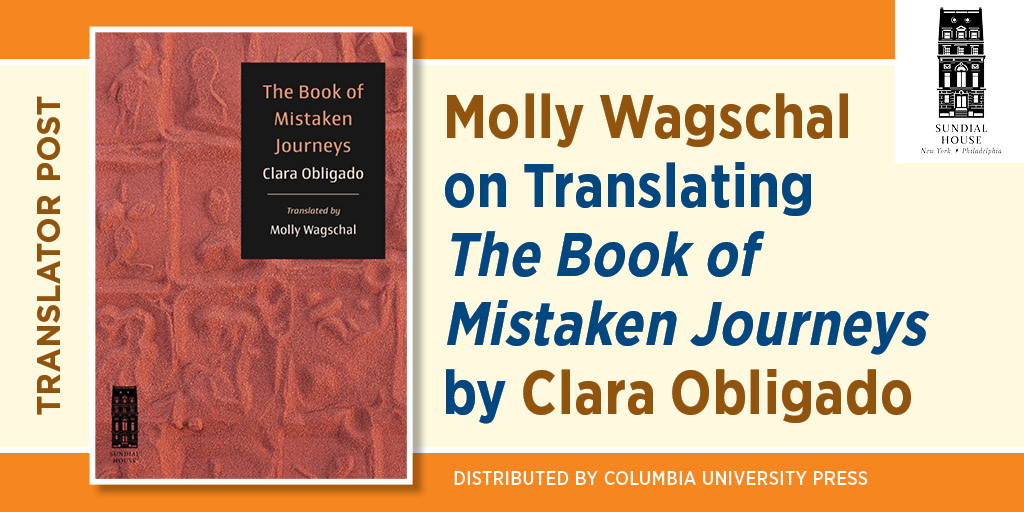
Molly Wagschal on Translating The Book of Mistaken Journeys by Clara Obligado
The title of Clara Obligado’s short-story collection, The Book of Mistaken Journeys, presents readers with an enigma: How could a journey or a trip be mistaken? Born in Buenos Aires in 1950, Obligado is no stranger to the enigmas of migration. In 1976, following the military coup in Argentina, she went into exile in Spain. Despite the possibility of returning to her home country after the fall of the military junta, she chose to stay in Madrid, where she has now lived for the majority of her life. This prolonged state of extranjería (foreignness) that Obligado describes as a condition of permanently living outside of Argentina plays a central role in her work. Indeed, almost all of the characters in The Book of Mistaken Journeys have migrated for various reasons—war, state violence, disaster, opportunity, love—and all feel fundamentally out of place. The work is a collection of eleven short stories, set in locations as diverse as Argentina, the Arctic Circle, and Albania, and in time periods ranging from the prehistoric era to the twenty-first century. And yet, as one starts to grasp in an initial reading, all the stories are interrelated. Some appear more clearly linked than others, yet even when individual plots seem disparate in time and place, together they form a larger network of subtle linguistic and thematic repetitions.
Each of the stories in The Book of Mistaken Journeys is complete on its own, but reading them together creates additional layers of narrative that an isolated reading precludes. This hybrid narrative style thus bends genre conventions, as the book falls somewhere between a novel and a collection of short stories. Obligado’s insistence on the short-story genre can perhaps be seen as a way of bridging the gap between what Mikhail Bakhtin called the “polyphonic novel” and the rich history of the Latin American short story, continuing the tradition of celebrated writers such as Gabriel García Márquez, Julio Cortázar, and Jorge Luis Borges. Along with the thematization of migration and the unique form of polyphonic prose, the image of the spiral emerges as a central feature, as if to organize the diverse voices and stories contained in the book. The first story, “Chance,” introduces the practice of what I will call “spiral reading”: reading with attention to thematic and linguistic repetitions in an effort to trace widening circles in the work and reconstruct textual spirals, small and large.
Along with the thematization of migration and the unique form of polyphonic prose, the image of the spiral emerges as a central feature, as if to organize the diverse voices and stories contained in the book.
“Chance” opens with two characters, Lyuba and Jan (who reappear later on), on a beach in Normandy, France. Lyuba discovers a spiraling conch shell in the sand and discards it, but Jan takes an interest: “Peering into the tiny windows that time has opened in the conch, he recognizes a logarithmic spiral; those ones that spin, widening around an infinitesimal point.” Here, Obligado describes the logic of the spiral that organizes the book. It starts from an “infinitesimal point” and expands in widening curves that repeat and evolve, evoking Rainer Maria Rilke’s epigraph. Following this logic, if one were to focus only on the smallest curves, she would not see the full spiral; one may not even realize that she is looking at a spiral. Therefore, it is necessary to take a step back and observe these recurring curves from a distance. Only then will the greater spiral be revealed.
I propose a reading of The Book of Mistaken Journeys that follows the same logic: If we read each story on its own, we see only the curve that it creates, but once we start connecting the stories to each other, we see that together they form widening curves and eventually culminate in the textual spiral that Obligado has reproduced as a paratext at the end of the book. That spiral structure would explain Obligado’s insistence, in her “Author’s Note,” that the stories be read in the order they appear. My hope is that each reader will find curious or meaningful connections in the work and pursue them through her own practice of spiral reading.
My hope is that each reader will find curious or meaningful connections in the work and pursue them through her own practice of spiral reading.
Postcolonial theorist Gayatri Spivak famously stated that “translation is the most intimate act of reading.” That is, we can think of translation not just as a written transmission of the source text into a different language but also as a closer way to approach the source text as readers. Translation as a form of close reading is particularly useful in the context of The Book of Mistaken Journeys, a work that should be read multiple times to apprehend the full range of connections among the stories. In the process of translating the collection, I read and reread each story many times, considering it as a full unit and also in relation to the others. Upon each reading, I discovered new details and connections, and I suspect that additional readings would continue to unearth even more curves and spirals.Reading the collection as its translator also enabled me to identify recurring terms that link the stories. For example, the repetition of the verb bambolear (to sway, wobble, lurch) to describe the body of the mammoth being excavated in “Cold,” the red balloon released by the little girl in “Black Holes,” and Kristina’s body atop her unsteady shoes in “Albania” invited me to explore how these stories are connected thematically. Of course, an attentive reader could identify linguistic repetitions without the intention of translating; what I want to argue is that the intimacy between the translator and the source text naturally encourages a closer reading.
My goal in translating The Book of Mistaken Journeys has been to create a version that flows in English while honoring the unique Spanish prose. Obligado writes in a dense, literary Spanish that is often difficult to re-create in English without altering syntax and punctuation. As her translator, I honor Clara Obligado’s repeating motives and terms, and thank her for welcoming me into her home in Madrid and answering my endless questions with grace and wisdom.
Molly Wagschal is a Ph.D. student at Brown University and the translator of Clara Obligado’s The Book of Mistaken Journeys.
This website uses cookies as well as similar tools and technologies to understand visitors’ experiences. By continuing to use this website, you consent to Columbia University Press’ usage of cookies and similar technologies, in accordance with the Columbia University Press Blog Cookie Notice.